Best Area to Stay in Chongqing for the Night View and the Shoot Corridor
Where you sleep in Chongqing decides which side of the camera you end up on. The peninsula puts you inside the picture; the south bank puts you in front of it.
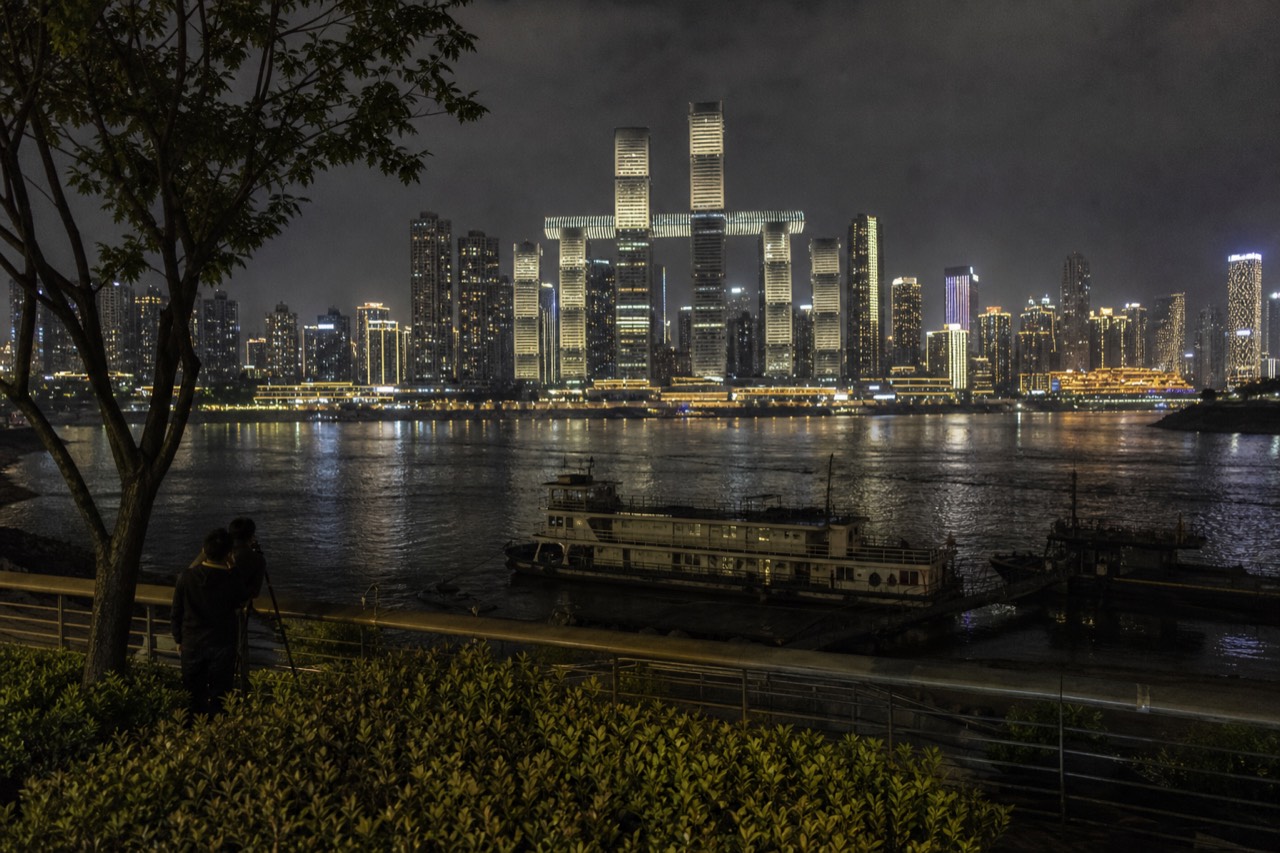
Short answer
Stay on the Nanbin Road south bank if the night skyline and the motorcycle shoot are the point: Danzishi station on the Loop Line serves the corridor, and the shoot meets at Nanbin Bell Tower Plaza. Stay at Jiefangbei or anywhere on the Yuzhong peninsula to be on foot among Hongyadong, Liziba and the cableway.
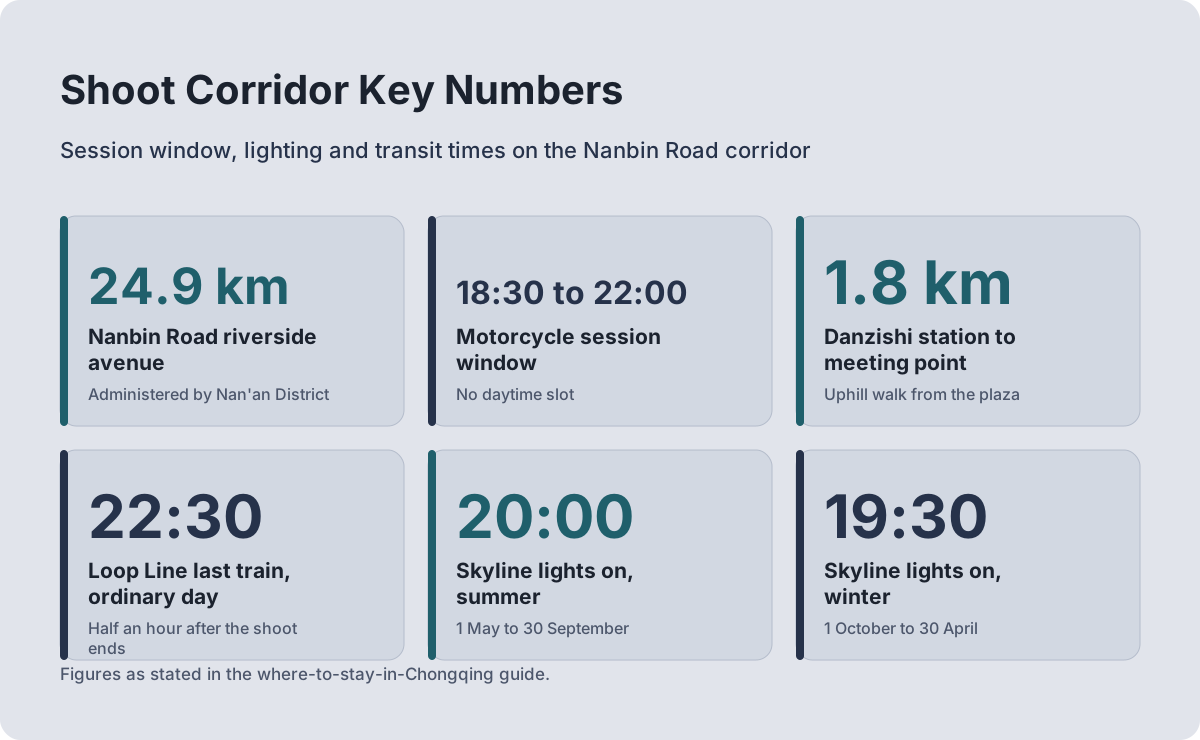
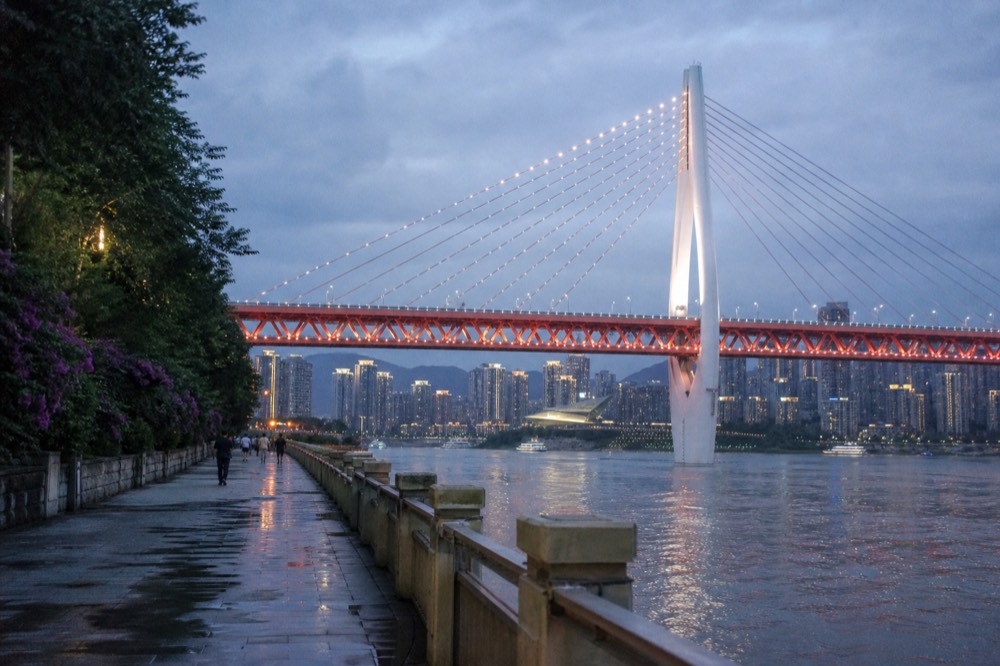
Chongqing splits cleanly along the Yangtze, and the split is photographic before it is anything else. The Yuzhong peninsula, on the north bank, is the skyline: the towers, the bridges, the layered streets everyone photographs from across the water. The Nanbin Road corridor on the south bank, roughly 24.9 km of riverside avenue administered by Nan'an District, is where those photographs are taken from. One side of the river is the subject. The other side is the camera position, and it is also where the viral motorcycle photoshoot actually happens.
That single fact does more to answer "where should I stay" than any hotel comparison can. This page walks through each area on that basis: what it puts you next to, which metro station serves it, and what it costs you in walking distance or price. If you are planning the whole visit, pair it with the one-day Chongqing itinerary and the guide to getting around the city.
Which area of Chongqing should you stay in?
The south bank if the night skyline and the motorcycle session are why you are flying in; the Yuzhong peninsula if you want to be on foot among the landmarks. Jiefangbei and the peninsula put you inside the picture, walking distance from Hongyadong, the cableway and Jiaochangkou station on Lines 1 and 2. The south bank puts you in front of the view, 1.8 km from Danzishi station to the shoot's meeting point at Nanbin Bell Tower Plaza.
Guanyinqiao, further north beyond the peninsula, trades both positions for lower room rates: you are out of the photogenic core and commuting into it. There is no wrong answer, only a trade between view, walking distance and price, and the table below is the honest summary of it.
| Area | What it puts you next to | Nearest station(s) | Who it suits |
|---|---|---|---|
| Nanbin Road south bank | The shoot corridor, the full Yuzhong skyline view across the Yangtze, Longmenhao Old Street | Danzishi (Loop Line), Shangxinjie (Loop Line, Line 6) | Photographers, anyone booked on the motorcycle session, night-view hunters |
| Jiefangbei / Yuzhong peninsula | Hongyadong, Jiefangbei, the Yangtze Cableway's north terminal, Chaotianmen | Jiaochangkou (Lines 1, 2), Xiaoshizi (Lines 1, 6, 18) | First-time visitors who want landmarks on foot |
| Guanyinqiao | A big local shopping and dining district, outside the core | Guanyinqiao (Line 3) | Travellers prioritising room price over location |
Two things the table cannot show. First, the peninsula is hilly in a way that rewrites walking times: the ridge rises from roughly 160 m at the riverside toward Eling, so a map distance of 800 m can be a staircase. Second, the south bank is not one neighbourhood: the stretch that matters for the shoot is the Danzishi-to-Bell-Tower stretch, and staying 10 km east along the same road does not put you in the corridor.
The south bank: staying inside the shoot corridor
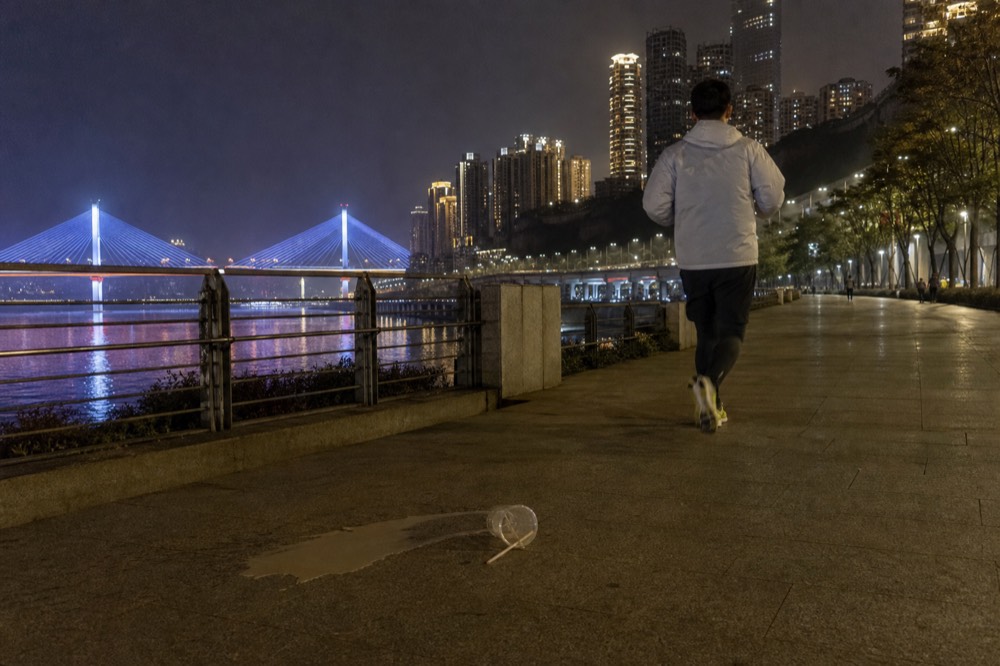
The south bank is the only area that puts you in the corridor where the motorcycle session actually runs. The listing meets at Nanbin Bell Tower Plaza on Nanbin Road in Nan'an District, runs 18:30 to 22:00 with no daytime slot, and uses the Yuzhong skyline across the Yangtze as its backdrop. Stay here and the shoot is a walk away; stay anywhere else and it is a crossing.
The Global Times described the scene plainly: motorcycles weaving along Nanbin Road with riders posing against the glittering skyline across the Yangtze, at designated spots along the road. That corridor is why this site exists, and it is the strongest single argument for basing yourself on the south bank if the session is on your list. The nearest station to the Bell Tower Plaza is Danzishi on the Loop Line, opened 1 July 2019, roughly 1.8 km north of the plaza; Shangxinjie station, served by both the Loop Line and Line 6, sits at the Dongshuimen Bridge end of the corridor. Both stations are shown on the station mapping in the night guide.
One caution travels with the corridor: two-wheeled motorcycles are banned on the Nanbin Road stretch between the Lanhua Road and Tengjiang Road junctions every day from 22:00 to 06:00, in force since 29 January 2024. That ban is exactly why the session window ends at 22:00, and it means the corridor goes quiet on two wheels after the last shoot wraps.
The corridor's other asset is Longmenhao Old Street, a restored terraced street beside Dongshuimen Bridge with an open, north-facing sightline to the Yuzhong skyline. It is a vantage point in its own right, single-source as a recommendation but consistent with the geometry: from the south bank you look north at the lit towers; from the peninsula you look south at a dark hillside. The drone light show billed as 新韵重庆 runs on Saturday evenings at 20:30 over the core riverfront airspace, with extra dates on public holidays, and the organiser publishes each month's dates separately, so a Saturday stay on the south bank can put the show outside your window.
Staying inside the corridor also solves the session's end-of-night problem. The shoot finishes at 22:00, the Loop Line's last train on an ordinary day is 22:30, and Danzishi station is a 1.8 km walk uphill from the plaza. A hotel within walking distance of Nanbin Road turns that arithmetic into a stroll rather than a taxi scramble. If you are weighing the video option, where a professional rider takes you pillion at 30 to 60 km/h while a photographer follows, being close to the meeting point matters even more.
North bank or south bank: which side has the view?
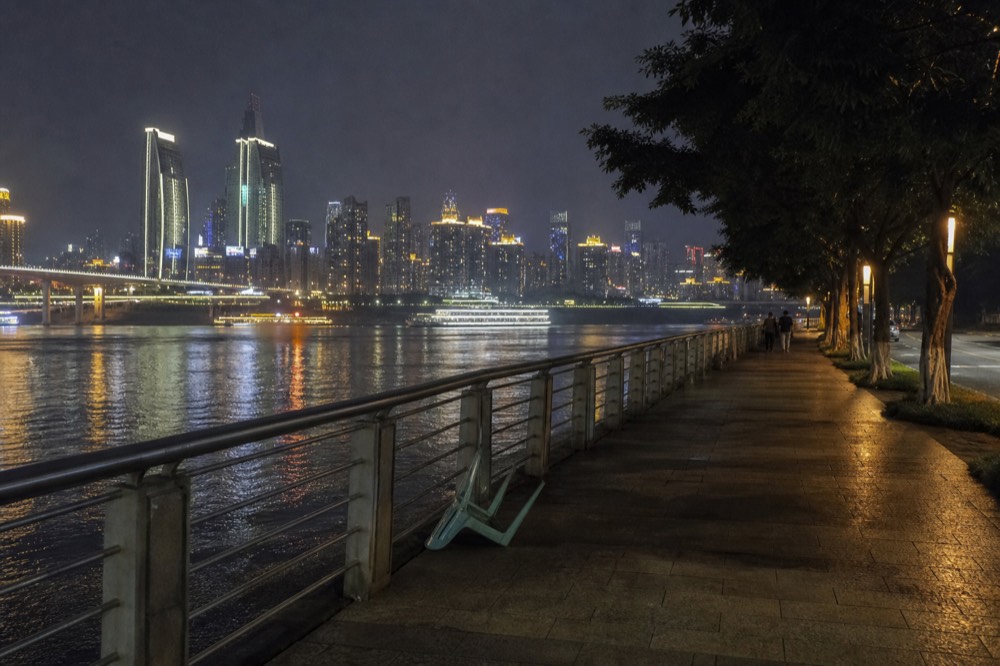
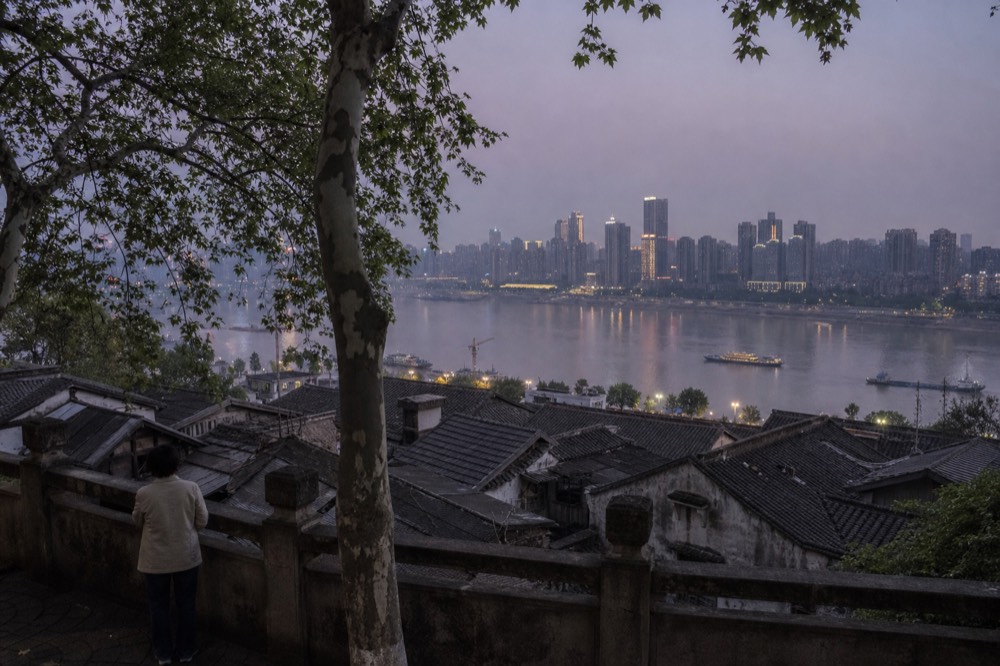
The north bank, meaning the Yuzhong peninsula, is the view. The south bank has the view. You cannot photograph the Yuzhong skyline from inside the Yuzhong peninsula, because from there the skyline is beneath and around you, and the only thing across the water is the dark south-bank hillside. Every famous frame of the lit peninsula, including the one the motorcycle session sells, is taken from the south bank or from a bridge.
This is the page's core argument, and it is worth stating bluntly because first-time visitors get it backwards. Hongyadong's famous night photographs are taken from Qiansimen Bridge or the far bank, not from inside Hongyadong, where you stand under the eaves. Raffles City, 354.5 m and 67 floors by Moshe Safdie, is the skyline's centrepiece seen from Nanbin Road; from its own footpath it is a shopping mall entrance.
| Question | North bank (Yuzhong peninsula) | South bank (Nanbin corridor) |
|---|---|---|
| Can you see the lit skyline? | Only fragments, from bridges and the Eling ridge | Yes, the whole peninsula face, unobstructed |
| Are the landmarks on foot? | Yes: Hongyadong, Jiefangbei, cableway, Chaotianmen | No, you cross the river for them |
| Is the motorcycle shoot walkable? | No, it meets on the south bank | Yes, within the corridor |
| Light timing at your window | You are inside the lit object | Lights on at 20:00 summer, 19:30 winter, across the water |
| Late-night transit | Line 2 and others to 23:00 | Loop Line to 22:30 on ordinary days |
The lighting schedule sharpens the difference. The "Two Rivers, Four Banks" core-area landscape lighting, which includes the Yuzhong skyline, the riverside towers and the bridges, switches on at 20:00 from 1 May to 30 September and 19:30 from 1 October to 30 April, off no earlier than 22:30 in summer and 21:30 in winter, with a two-hour extension over Spring Festival and National Day. The Chongqing Municipal Urban Administration Bureau publishes the times; nothing about the switch-on follows the sunset, it runs on fixed clock times. A south-bank window over the water therefore has a dependable nightly show. A peninsula window has the inside of the show.
Jiefangbei and the peninsula base
Jiefangbei is the peninsula's default base, and its argument is density: the People's Liberation Monument pedestrian district on foot, Hongyadong roughly 15 minutes' walk away, the Yangtze Cableway's Xinhua Road terminal nearby, and Jiaochangkou station on Lines 1 and 2 underneath it all. Stay here and you never need to plan a journey to a landmark, because the landmarks are the neighbourhood.
The trade is the one the last section made: you are inside the photographed object, not in front of it. Hongyadong, the eleven-storey stilt-house complex built into the cliff above the Jialing, opened in its current form in 2006 and is free to enter, though reservation is advised at peak periods and a February 2025 government notice set its illumination at 18:30 to 23:00. Xiaoshizi station, on Lines 1, 6 and 18, is the stop for both Hongyadong and the Chaotianmen peninsula tip, where the Jialing meets the Yangtze behind Raffles City.
The cableway is the peninsula base's quiet ace. The Yangtze River Cableway has crossed the river since 24 October 1987, 1,166 m at 6 m per second, about 3.6 minutes in the cabin, with fares set by government notice at a maximum of 30 yuan one way and 50 yuan return. It runs from Xinhua Road in Yuzhong to Shangxinjie on the south bank, which means a Jiefangbei base has a scenic, direct, ride-in-the-sky link straight into the shoot corridor's eastern end. That single ride collapses the north-versus-south argument more elegantly than any metro transfer.
If a static photo with a parked bike is what you booked, the peninsula works fine as a base: the photo package includes no ride at all, just 15 minutes of posed shooting with the motorcycle as a prop, with all the negatives plus 9 retouched photos delivered by email or WeChat within 1 to 3 days. The session still meets on the south bank, so you cross the river for it, but the crossing is one cableway ride or a short metro hop.
Guanyinqiao and the price trade-off
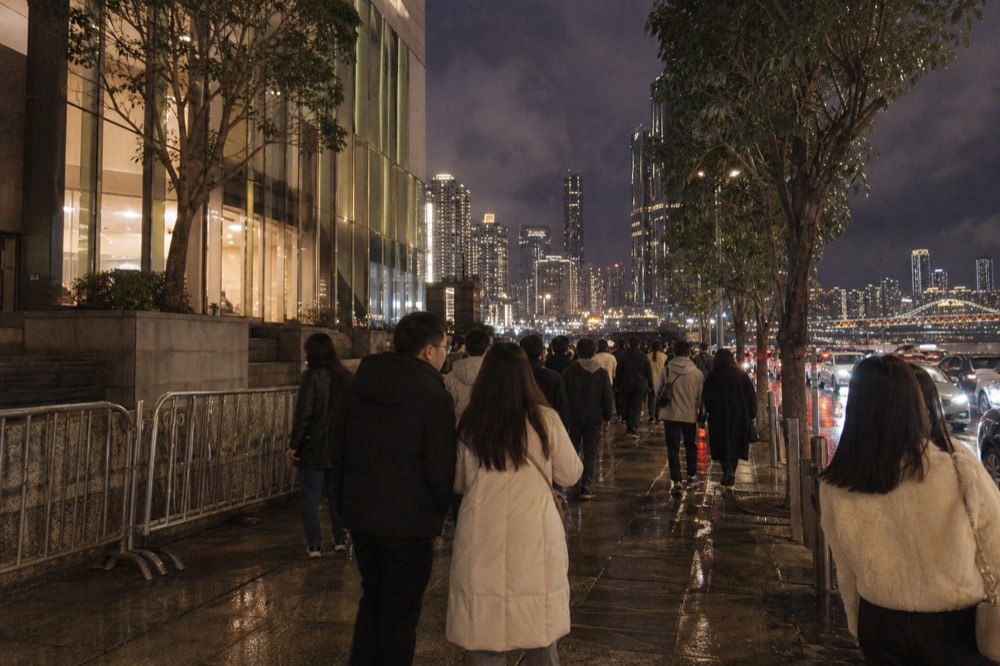
Guanyinqiao, on Line 3 north of the peninsula, is where room rates drop and the trade is distance: you are outside the photogenic core, commuting into it by metro, in exchange for cheaper beds and a big local shopping and dining scene that is not built around tourists. It suits travellers whose trip is bigger than the skyline, or whose budget is tighter than the view.
The commute is not punishing. Guanyinqiao sits on Line 3, and the metro network is extensive: 12 lines, 324 stations, 574.12 km, mixing conventional metro with straddle-beam monorail, with fares from 2 yuan for trips up to 4 km under the distance-banded tariff in force since 30 July 2025. Lines 1, 2, 3, 4, 5, 6 and 10 run 06:30 to 23:00 every day; the Loop Line, which serves the shoot corridor, stops at 22:30 on ordinary days and 23:00 on holidays and the day before. For how the whole system fits together, see getting around Chongqing.
What Guanyinqiao cannot give you is a window on anything. The area's own attractions, the pedestrian street and the food scene, are genuinely good and genuinely local, but nothing in the frame is the Chongqing that 1.52 billion video views are about. If the motorcycle session is a maybe rather than a must, and the room saving matters, it is a defensible base; if the session is the point, it is the wrong side of the river twice over, because you commute to the shoot and then commute home from it after 22:00.
The after-22:00 detail is worth one sentence of planning. A taxi at that hour is still on the daytime tariff, since the daytime band runs to 23:00: 10 yuan flag-fall covering the first 3 km, then 2 yuan per km. That is the realistic way home from the shoot if your bed is not in the corridor, and it is cheap enough that Guanyinqiao's saving survives it, at the cost of a 20-minute ride.
How far is each area from the shoot's meeting point?
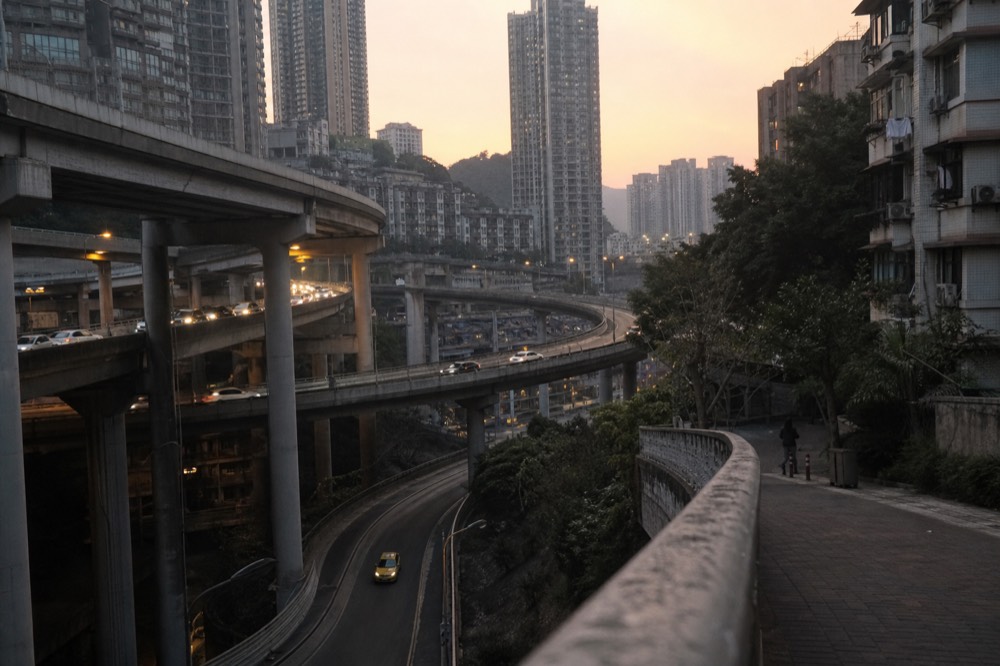
From Danzishi or anywhere on the Nanbin corridor, the meeting point at Nanbin Bell Tower Plaza is a walk. From Jiefangbei, it is one metro ride with a transfer, or the cableway plus a short walk, or a taxi of roughly 10 to 20 minutes depending on traffic and bridge choice. From Guanyinqiao, it is a two-line metro journey or a longer taxi ride across the whole peninsula.
The crew confirms the exact meeting spot after booking, and the plaza itself is an area rather than a pin, so treat the last few hundred metres as something you confirm on arrival. The table gives the realistic picture per base; the taxi column uses the daytime tariff, 10 yuan for the first 3 km then 2 yuan per km, which applies because the session ends at 22:00, inside the daytime band.
| Base | Mode to Nanbin Bell Tower Plaza | The journey in practice |
|---|---|---|
| Nanbin corridor (Danzishi area) | On foot | Roughly 1.8 km from Danzishi station to the plaza; if your hotel is on the corridor itself, less |
| Jiefangbei | Metro with transfer | Jiaochangkou to Shangxinjie via the network, then walk the corridor's eastern end; or the cableway from Xinhua Road to Shangxinjie, then walk |
| Jiefangbei | Taxi | Across the river, roughly 10 to 20 minutes depending on traffic; daytime tariff applies at 22:00 |
| Guanyinqiao | Metro | Line 3 into the network, transfer toward the Loop Line, alight at Danzishi or Shangxinjie, then walk |
| Anywhere | After the session | Shoot ends 22:00; Loop Line last train 22:30 on ordinary days; taxi at the daytime rate to 23:00 |
Note the asymmetry in that last row. Ending inside the corridor, you walk to bed. Ending anywhere else, you have half an hour to make a station that is itself a kilometre-plus from the plaza, or you take the taxi. Neither is a problem, but only one of them is a decision you will be glad you made at 22:05 in the rain, and Chongqing averages 149.1 days a year with rain in the measurable range, so the rain scenario is not hypothetical.
What can you see on foot from each area?
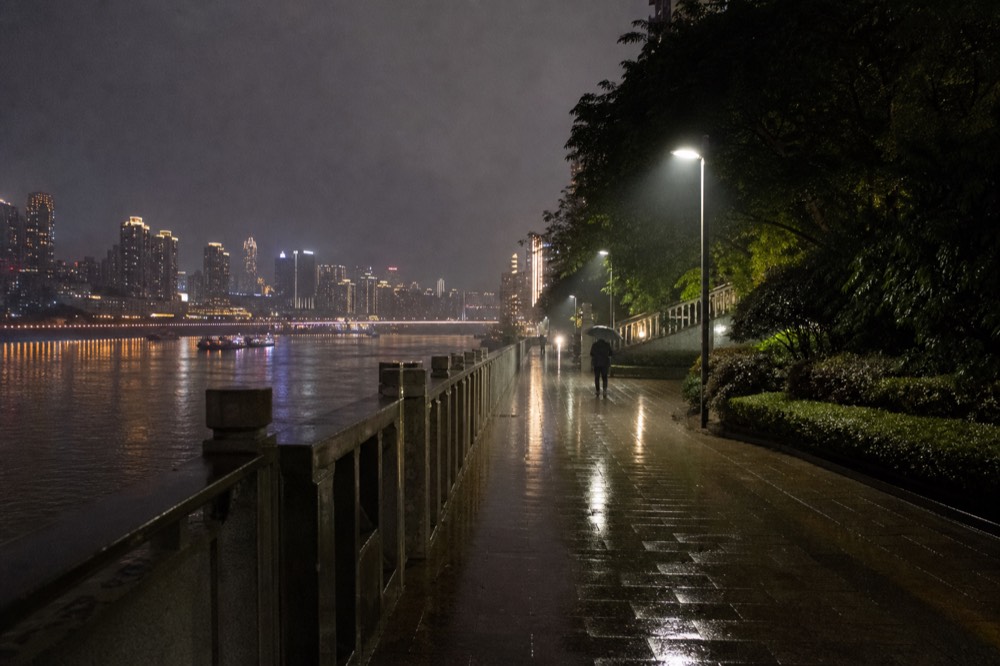
A Jiefangbei base puts Hongyadong, Jiefangbei, Chaotianmen, the cableway terminal and Eling Park's ridge walk within reach without a ticket or a metro ride. A Nanbin corridor base puts the entire lit peninsula face, Longmenhao Old Street and the riverside promenade on foot, every night, free. Guanyinqiao puts a large local shopping district on foot and nothing else that this site covers.
The honest framing is that the peninsula owns the objects and the south bank owns the view of them, and both are free to stand in front of. The peninsula's walkable list is longer; the south bank's single item, the skyline across the water, is the one that made the city famous on video.
| Area | Free on foot | Worth a ticket |
|---|---|---|
| Jiefangbei / peninsula | Jiefangbei pedestrian district, Hongyadong exterior, Chaotianmen confluence, Eling Park (high point of the peninsula, first laid out in 1909) | Yangtze Cableway, 30 yuan one way maximum, 50 yuan return |
| Nanbin corridor | The full Yuzhong skyline view, the promenade, Longmenhao Old Street, Dongshuimen Bridge sightlines | The motorcycle session itself, from about $52.85 |
| Guanyinqiao | Guanyinqiao pedestrian street and food scene | Everything else, by metro |
One peninsula item deserves its own word: Eling Park, served by Eling station on Line 1, is the high point of the peninsula and the one place on the north bank where you do get a view, south over the river. It is the exception that proves the rule, because from Eling you are looking out over the south bank rather than at the peninsula itself. The rest of the peninsula's famous frames, including the monorail-through-building shot at Liziba on Line 2, are experiences you stand inside, not views you take home. For the fuller list of vantage points, see the cyberpunk photo spots guide.
Does when you visit change where you should stay?
Yes, mainly through the light. The session window is fixed at 18:30 to 22:00, but the skyline lighting switches on at 20:00 in summer and 19:30 in winter, and sunset swings from about 18:00 at the December solstice to 19:58 in late June. A winter stay compresses the lit window into the last half of a session; a summer stay makes the switch-on coincide almost exactly with the end of sunset.
Chongqing sits at 106.55 degrees east while the whole country runs one clock off the 120E meridian, so solar noon lands about 50 minutes after clock noon and evening light runs late in a way that surprises visitors. Late June gives you sunset at 19:58, civil twilight to 20:24, lights on at 20:00: the blue hour and the switch-on nearly coincide. Late December gives sunset at 18:00, twilight ending 18:25, and the skyline dark until 19:30. Neither is bad for photography, but they are different plans, and the best time to visit guide works through the whole calendar, including the two-hour lighting extension over Spring Festival and National Day that keeps the skyline lit until roughly 23:30 on Golden Week nights.
Weather argues for the south bank too, mildly. The city averages 37.2 foggy days a year, concentrated October to February, with December the foggiest month at about 6.8 days. Fog softens the skyline from across the river into something cinematic; from inside the peninsula it just reduces visibility. August, the clearest month at about 1.3 foggy days, is also the hottest, with mean daily maxima of 33.9 C and the Shapingba station's record high of 43.7 C set in August, so summer stays favour a corridor with restaurants and air-conditioned retreats within a few hundred metres.
Foreign visitors fitting the trip around entry rules should also check the current policy before booking anything: China runs a 240-hour, 10-day visa-free transit scheme for nationals of 57 countries through designated ports, and the National Immigration Administration publishes the authoritative list. Chongqing Jiangbei International Airport is an eligible port, and CKG's immigration checkpoint handled more than 1.48 million inbound and outbound passengers in the first half of 2026, up 39.5 percent, the fastest growth among China's ten largest airports, so the arrival experience is busier than it was.
The session itself comes in two genuinely different packages, and which one you pick should come before the hotel, not after, because the video option changes what your evening looks like. The comparison below is the whole inventory this site covers, one listing sold as two options.
| Photo package | Video package | |
|---|---|---|
| What it is | 15 minutes of posed shooting with a parked motorcycle, no ride | A pillion ride with a professional rider, a photographer following, action guidance |
| Age rule | No age limit stated | 18 or over |
| What you receive | All the negatives plus 9 retouched photos | One edited video, 25 to 35 seconds; stills not promised |
| Price | HK$414, the "from about $52.85" per-person figure | HK$482, about 16 percent more |
| Delivery | Email or WeChat within 1 to 3 days | Email or WeChat within 1 to 3 days |
The price gap between them is small; the experience gap is not. The photo package is, in the operator's own words, static photo shooting only, with no riding experience. The video package is a ride that produces a short film, at 30 to 60 km/h, with a helmet provided, service in Chinese with no English-speaking rider guaranteed, and free cancellation with no published window. Choosing on price alone is how the listing's one-star review happened, and it is why this site, Chongqing Motorcycle Photoshoot, exists to explain the difference rather than just link it. For what a night out costs beyond the session, see is Chongqing expensive for tourists.
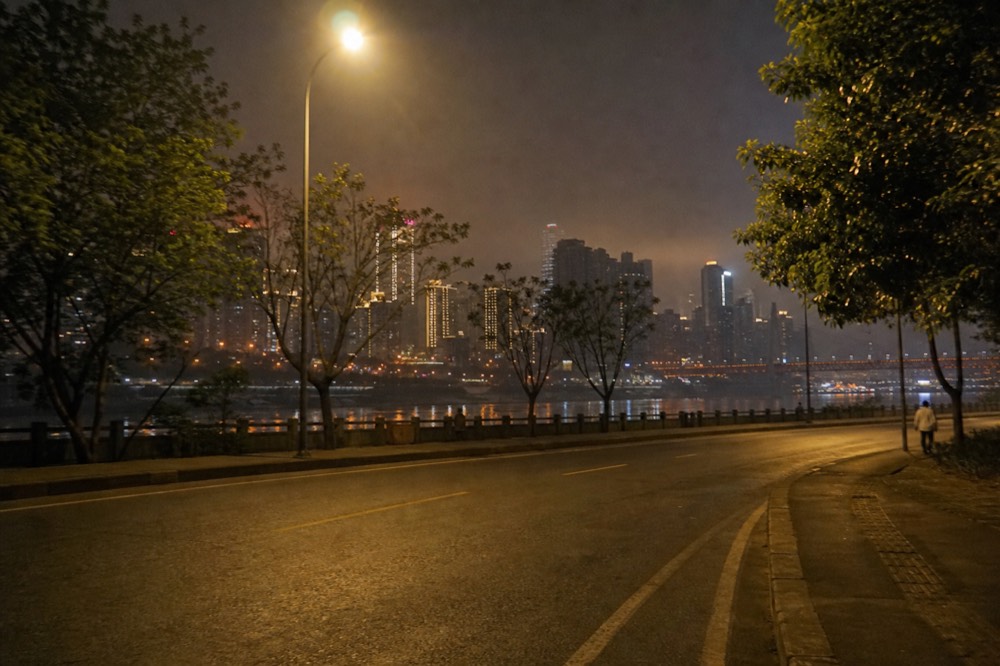
The decision, restated one last time as a rule of thumb: book the session first, then sleep on the same side of the river it meets on. The south bank corridor around Danzishi and Longmenhao is the only base that puts the meeting point, the view, the promenade and your bed inside one walkable stretch, and every other area is a beautiful place that requires a crossing at 22:00. If the peninsula's landmarks matter more to you than the frame they appear in, Jiefangbei is the base, the cableway is your bridge to the shoot, and the compromise is honest. If the budget is the constraint, Guanyinqiao works and the taxi home is cheap; just do not pretend it is a view.
The recurring questions are simple: which side of the river, whether the peninsula has any view at all, how to reach the shoot's meeting point, and whether season or budget changes the answer. Each one is answered directly below, with the station names, times and fares that actually decide it.
Common questions about where to stay in Chongqing
Which area of Chongqing should you stay in?
Stay on the Nanbin Road south bank if the night skyline and the motorcycle session are the point; the corridor is served by Danzishi and Shangxinjie stations on the Loop Line. Stay at Jiefangbei on the Yuzhong peninsula to be on foot among Hongyadong, the cableway and the shopping district. Guanyinqiao trades location for lower room rates.
Can you see the Chongqing skyline from the Yuzhong peninsula?
No, not the famous frame. The peninsula is the skyline: from inside it the lit towers are around and beneath you, and the far bank is a dark hillside. Every well-known photograph of the lit peninsula is taken from the south bank or from a bridge such as Qiansimen.
How do I get to the motorcycle shoot meeting point?
The session meets at Nanbin Bell Tower Plaza on Nanbin Road, confirmed by the crew after booking. From the corridor it is a walk; from Jiefangbei it is one metro ride with a transfer, or the Yangtze Cableway to Shangxinjie then a walk, or a taxi. The session ends at 22:00 and the Loop Line's last train on an ordinary day is 22:30.
Is the south bank or north bank better for photography?
The south bank, for the city's signature image. The core-area landscape lighting switches on at 20:00 from May to September and 19:30 from October to April, and the whole peninsula face is visible from the Nanbin corridor. The north bank offers Eling Park's ridge as its one genuine outward view, plus the interiors of the landmarks themselves.
Where should I stay in Chongqing on a budget?
Guanyinqiao, on Line 3, north of the peninsula, is the standard trade: lower room rates, a strong local dining and shopping scene, and a metro commute into the photogenic core. Fares start at 2 yuan for trips up to 4 km, and a taxi after the 22:00 session end still runs on the daytime tariff, 10 yuan covering the first 3 km, until 23:00.
Does the season change where I should stay?
It changes the light, which changes the evening. Sunset runs from about 18:00 at the December solstice to 19:58 in late June, while the skyline lights come on at fixed clock times, so winter compresses the lit window into a session's second half and summer aligns the switch-on with the end of sunset. Fog is heaviest October to February and clearest in August, which is also the hottest month.