Chongqing Metro and Transport: Getting to Nanbin Road for a Night Shoot
Chongqing runs twelve rail lines across 574.12 km and 324 stations, mixing conventional metro with straddle-beam monorail, but the journey most visitors actually need to plan is the one almost no itinerary covers: crossing the rivers to the south bank before the city lights come on.
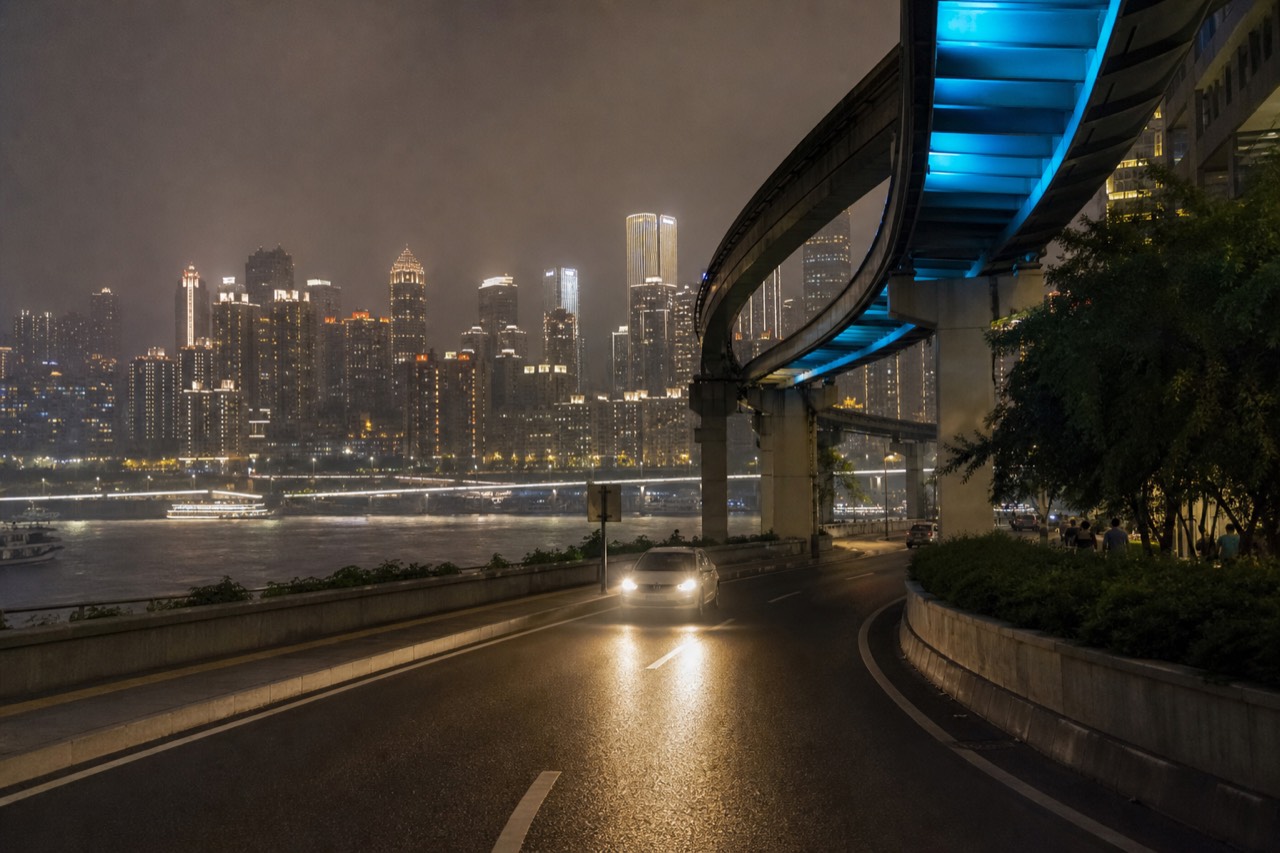
Short answer
Chongqing Rail Transit runs 12 lines and 324 stations over 574.12 km. The Nanbin Road shoot corridor is served by Shangxinjie on the Loop Line and Line 6, and by Danzishi on the Loop Line. Sessions run 18:30 to 22:00, and two-wheelers are banned on Nanbin Road from 22:00, so the last metro home matters as much as the ride out.
How do you get around Chongqing as a visitor?
Chongqing Rail Transit runs twelve lines, thirteen counting the International Expo Line, over 574.12 km and 324 stations, mixing conventional metro with straddle-beam monorail, and it began trial operation in November 2004. For a visitor the network does something few cities manage: it goes where your legs would rather not, straight up and across the mountain ridges that make walking Chongqing a workout.
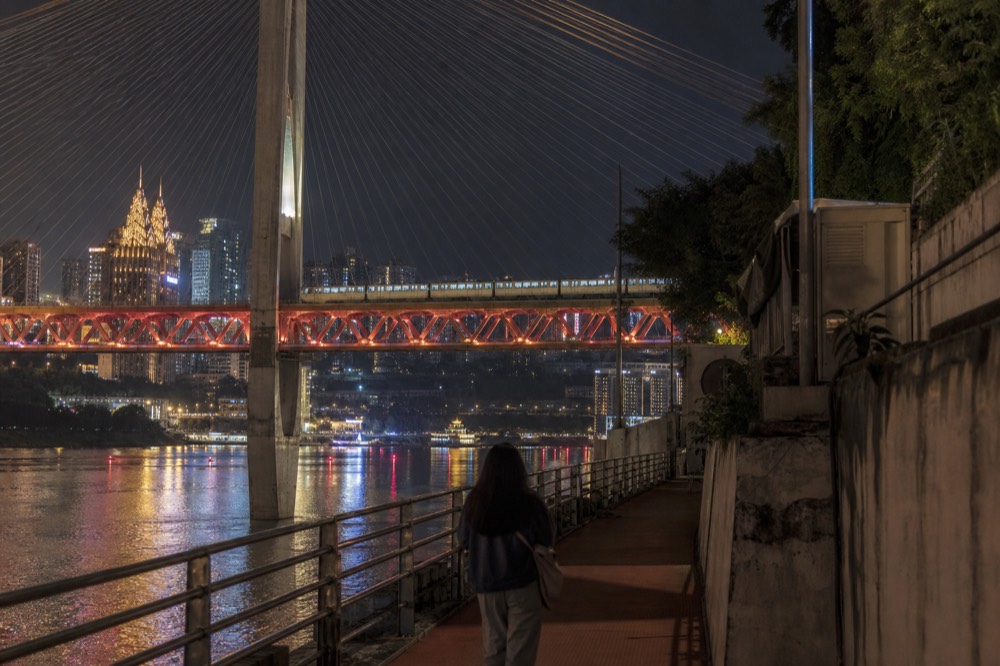
The network's headline numbers come from the operator and the official record: 12 lines, 324 stations, 574.12 km of route, headways of 2.5 to 12.5 minutes, an annual ridership of 1.445 billion in 2024, and a peak single day of 6.15 million on 31 December 2025. Those are network facts, useful for scale rather than planning. What matters for your evening is narrower: which line reaches the south bank, how late it runs, and what happens after the shoot finishes.
The geography is the thing to grasp first. Chongqing is built on a peninsula between two rivers, the Yangtze and the Jialing, with the Yuzhong peninsula as the tourist core on the north side and the Nanbin Road corridor facing it across the water on the south bank. The two levels of the city sometimes mean a metro station exits above your hotel roof, which is charming at noon and disorienting at 22:00. The Liziba monorail station is the famous example, a Line 2 station threaded through floors 6 to 8 of a residential building, but the layered-exit effect repeats all over the network. This page is the transport companion to Chongqing Motorcycle Photoshoot, the site that covers the Nanbin Road shoot itself.
Here is how the main modes compare for a visitor, including what the published record simply does not give you.
| Mode | What it is genuinely good for | What is not published |
|---|---|---|
| Metro and monorail | Cross-river and cross-hill trips, fixed headways, immune to traffic | No day-pass price or tourist product appears in any municipal notice; fares are distance-based and bought at gates or in-app |
| Yangtze River Cableway | A 1,166 m aerial crossing with a view, a genuine transport link since 1987 | Seasonal operating hours shift and the operator publishes them; no fixed timetable appears in any official document we could read |
| River ferries and night cruises | Sightseeing from the water, evening departures | Departure schedules and fares appear only on aggregator sites, not in a primary source |
| Taxi | The realistic option after 22:00, when the shoot ends | Metered tariff is published by the transport commission; app-based ride prices are dynamic and nowhere published |
A practical note on the last row: after your session ends at 22:00, the metro option narrows sharply, which is covered below. A taxi is the dependable choice, and Chongqing's published tariff for the main urban area runs 10 yuan for the first 3 km in the daytime band, which extends to 23:00, then 2 yuan per km, per the municipal transport commission's policy answer on taxi billing.
Which metro stations serve Chongqing's main landmarks?
Every major sight in central Chongqing has a named station, and the mapping below is taken from each station's own reference rather than from a hotel concierge's guess. Xiaoshizi serves Hongyadong with Lines 1, 6 and 18; Jiaochangkou serves Jiefangbei with Lines 1 and 2; Linjiangmen serves the Kuixinglou area with Line 2; and the south-bank shoot corridor is served by Shangxinjie and Danzishi.
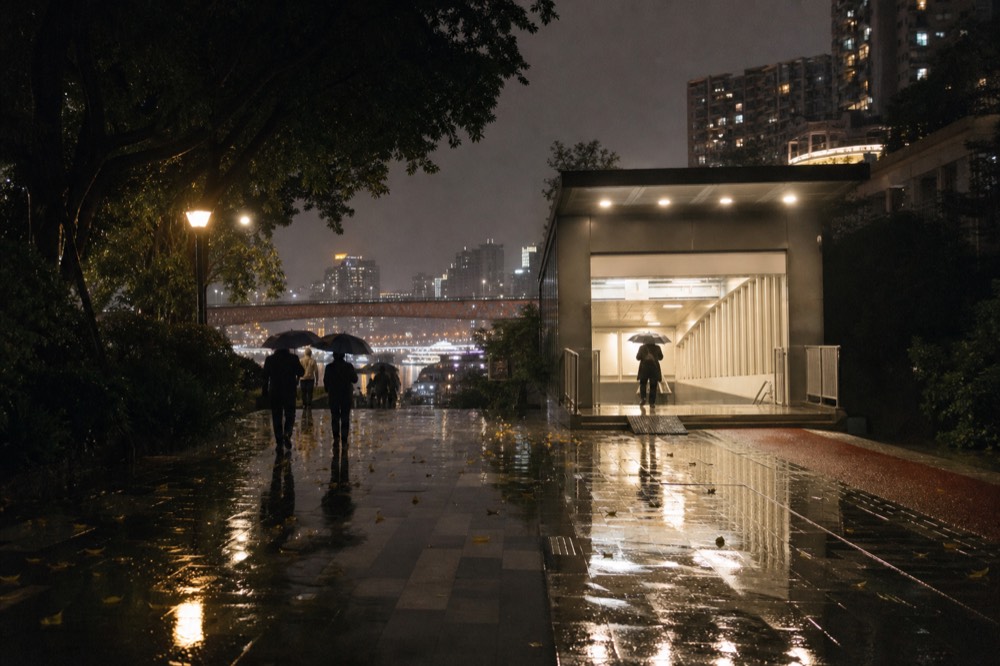
Getting the station right is half the journey in a city where exits can be a vertical hundred metres apart. The table is the whole answer; print it or screenshot it.
| Landmark | Station | Line or lines |
|---|---|---|
| Hongyadong stilt houses | Xiaoshizi | 1, 6, 18 |
| Chaotianmen and Raffles City | Xiaoshizi / Chaotianmen | 1, 6, 18 / 1 |
| Jiefangbei and Shibati | Jiaochangkou | 1, 2 |
| Kuixinglou skybridge area | Linjiangmen | 2 |
| Eling Park and Testbed 2 | Eling | 1 |
| Liziba monorail-through-building | Liziba | 2 |
| Nanbin Road shoot corridor, west end | Shangxinjie | Loop Line, 6 |
| Nanbin Road shoot corridor, Danzishi end | Danzishi | Loop Line |
| Wider south bank, Haitangxi area | Haitangxi | opened 28 December 2018 |
Two entries deserve a sentence each. Shangxinjie sits at Tushan Road and Dongshuimen Bridge, which makes it the natural station if you are coming from the peninsula and want to walk down to the riverside. Danzishi, opened 1 July 2019 on the Loop Line, is the nearest station to Nanbin Bell Tower Plaza, the meeting point for the motorcycle shoot, at roughly 1.8 km, so it is closer on the map than in practice; the last stretch is a riverside walk or a short taxi hop.
For the wider context of what to build your days around, the Chongqing itinerary guide lays out the sightseeing sequence, and the where to stay in Chongqing guide helps you pick a base that keeps these station changes short. If you are arriving on a 240-hour visa-free transit entry, the rules and port list are covered in the China 240-hour visa-free transit guide, and the National Immigration Administration publishes the current policy on its visa-free transit page, which is worth reading before you book anything.
How do you cross to the south bank in time for an 18:30 start?
Shangxinjie on the Loop Line and Line 6, and Danzishi on the Loop Line, are the corridor's actual access stations, and the timing constraint is real: sessions run 18:30 to 22:00, the Yuzhong skyline lighting switches on at 19:30 in winter and 20:00 in summer, and two-wheeled motorcycles are banned on Nanbin Road from 22:00 every day.
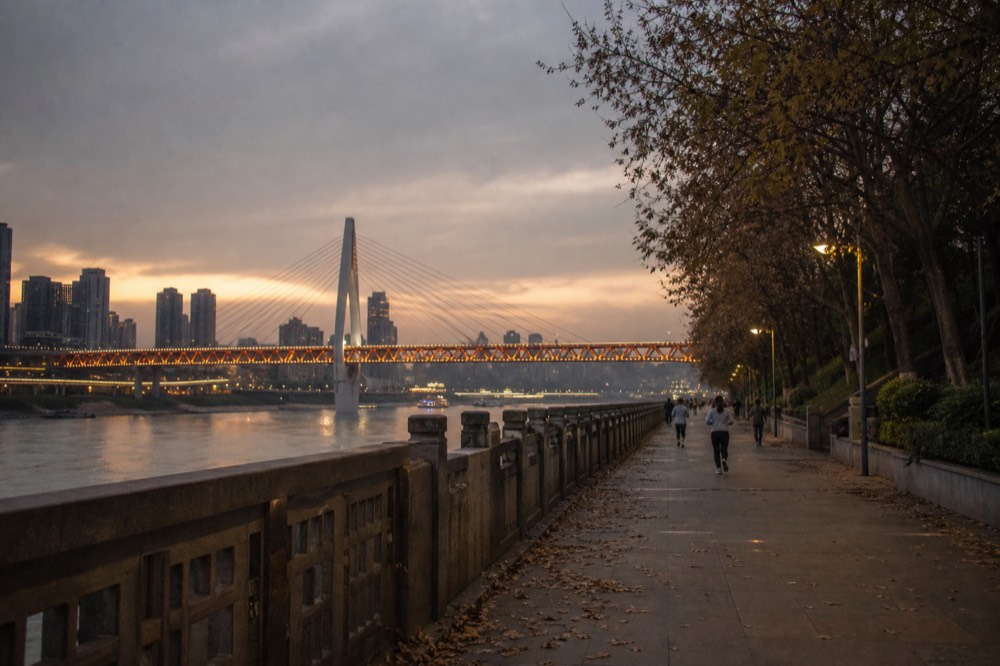
This is the journey that deserves planning, because it is genuinely different from the Yuzhong sightseeing most visitors build their trip around. You are crossing the Yangtze, in the evening rush, to a riverside road on the far bank, and arriving late costs you the lit part of the session rather than just the first few minutes. Work backwards from the light. The "Two Rivers, Four Banks" core-area lighting, which includes the Yuzhong skyline and the cross-river bridges you will be photographed against, switches on at 19:30 from 1 October to 30 April and at 20:00 from 1 May to 30 September, under the municipal urban administration bureau's published schedule. An 18:30 arrival means you shoot the warm-up and posed segment first, then the skyline arrives behind you.
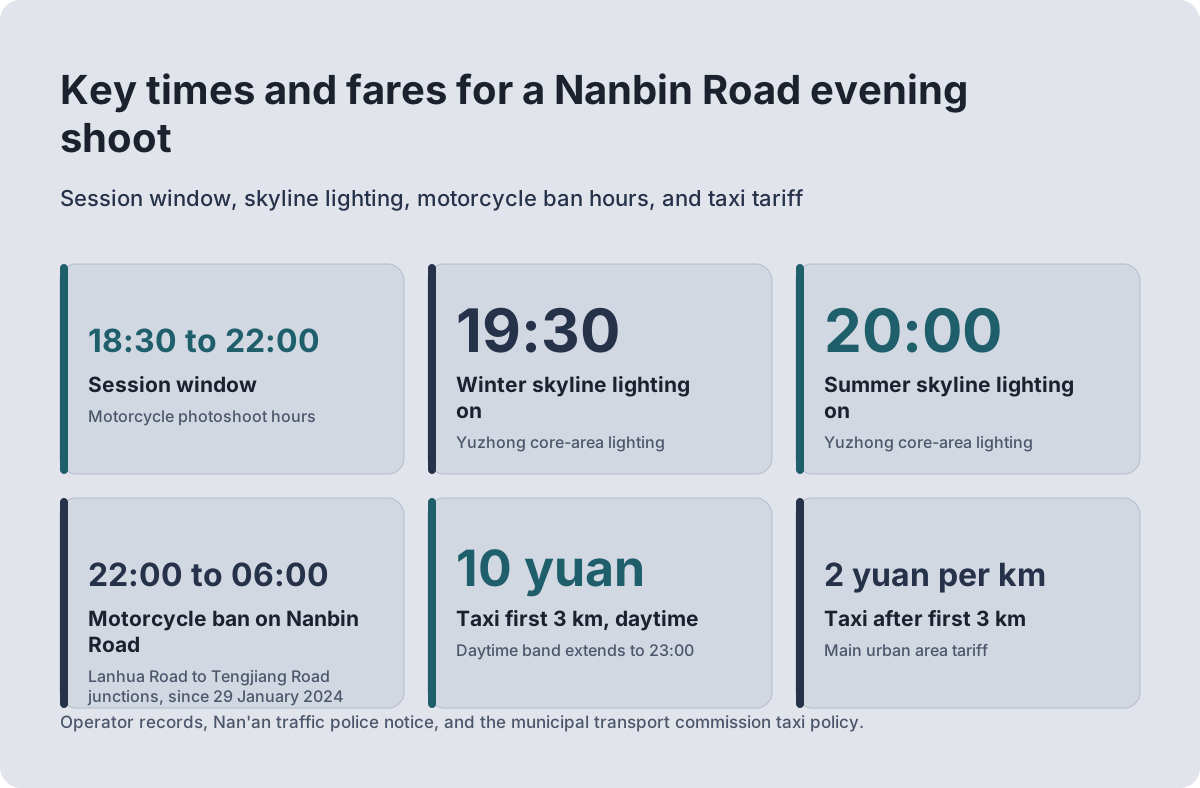
The 22:00 end is not the operator being fussy. Two-wheeled motorcycles are banned on the stretch of Nanbin Road between the Lanhua Road and Tengjiang Road junctions from 22:00 to 06:00 every day, in force since 29 January 2024, under a Nan'an traffic police notice published by the Chongqing municipal government. That ban is why the session window ends when it does, and it is the single most useful transport fact on this page: whatever else your evening plan is, it must assume the ride stops at 22:00.
If you are booked on the video package, the one with the pillion ride, arriving at the meeting point at Nanbin Bell Tower Plaza with time to spare matters even more. The crew confirms the exact spot after booking, the ride runs at 30 to 60 km/h with a professional rider and a photographer following, and the whole thing is built around the lit window. Files arrive by email or WeChat within 1 to 3 days, so a rushed start does not ruin the shoot, but a late one eats directly into the only hours when the backdrop looks the way it does in the videos that made the trend famous.
How do you reach Nanbin Bell Tower Plaza from the main visitor bases?
From Jiefangbei or Xiaoshizi on the peninsula, the straightforward route is Line 6 or the Loop Line to Shangxinjie and then a walk or short taxi down to the river; from Jiaochangkou, transfer to the Loop Line and alight at Danzishi. Allow a realistic buffer of at least an hour door to door for an 18:30 start, because the last stretch is not rail-served.
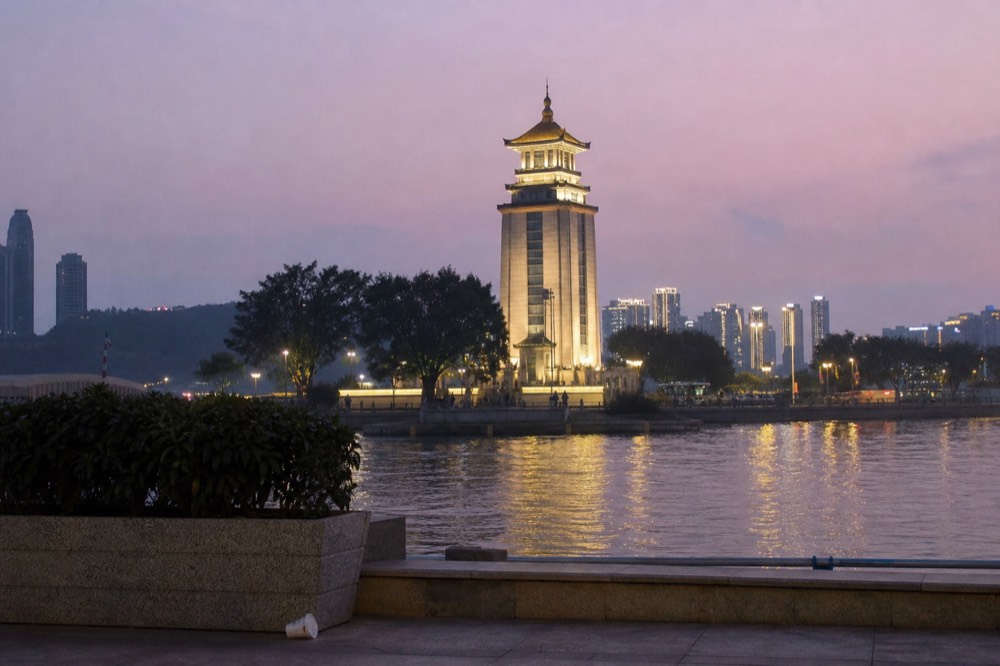
Nanbin Bell Tower Plaza, the published meeting point, sits on the south bank riverside, and the listing is candid that the crew confirms the exact spot after booking. Treat the plaza as an area rather than a pin. Danzishi station is roughly 1.8 km from it, which is a 20 to 25 minute riverside walk or a short taxi ride; Shangxinjie is slightly further west but drops you closer to the Dongshuimen Bridge end of the corridor. Neither is a bad choice, and the direction you come from should decide.
| Starting base | Station to start from | Route | Realistic buffer for an 18:30 start |
|---|---|---|---|
| Jiefangbei | Jiaochangkou (Lines 1, 2) | Loop Line to Danzishi, then walk or taxi to the plaza | About an hour |
| Hongyadong | Xiaoshizi (Lines 1, 6, 18) | Line 6 toward the south bank, or transfer to the Loop Line for Danzishi | About an hour |
| Liziba | Liziba (Line 2) | Line 2 toward Jiaochangkou, transfer to the Loop Line, alight Danzishi | Ninety minutes or so |
| Airport hotel or T3 | Terminal 3 (Line 10) | Line 10, transfer to the Loop Line at a connecting station, then Danzishi | Two hours plus, and check the last trains before committing |
Build the buffer around three things. First, transfers on the Loop Line are not always short; the network's layered exits add walking time that a flat map hides. Second, the evening rush between roughly 18:00 and 19:00 fills trains heading out of Yuzhong, and a bike or a large camera bag makes the squeeze real. Third, and most importantly, the meeting-point confirmation comes from the crew after booking, so you want to be on the corridor, not still underground, when that message lands. An hour of slack is not paranoia; it is the difference between starting in daylight and starting in the lit window.
The session listing itself covers about 30 minutes per person, with the listing giving a 15 to 45 minute range, meeting at Nanbin Bell Tower Plaza, with a helmet provided, one person per booking, and service in Chinese with no English-speaking rider guaranteed, which is one reason the is Chongqing English-friendly article is worth reading before you go.
The full session listing carries free cancellation with no published window, so transport uncertainty is not a reason to delay booking: lock the slot, then work out the route with the buffers above.
Is the photo package the calmer option if you would rather not ride pillion?
Yes, if the ride itself is the part that worries you, the photo package is the calmer choice: it includes no motorcycle ride at all, the bike is a prop you pose with for 15 minutes, and you receive all the negatives plus 9 retouched photos, from about $52.85 per person. The video package is the one with the pillion ride, and it is restricted to ages 18 and over.
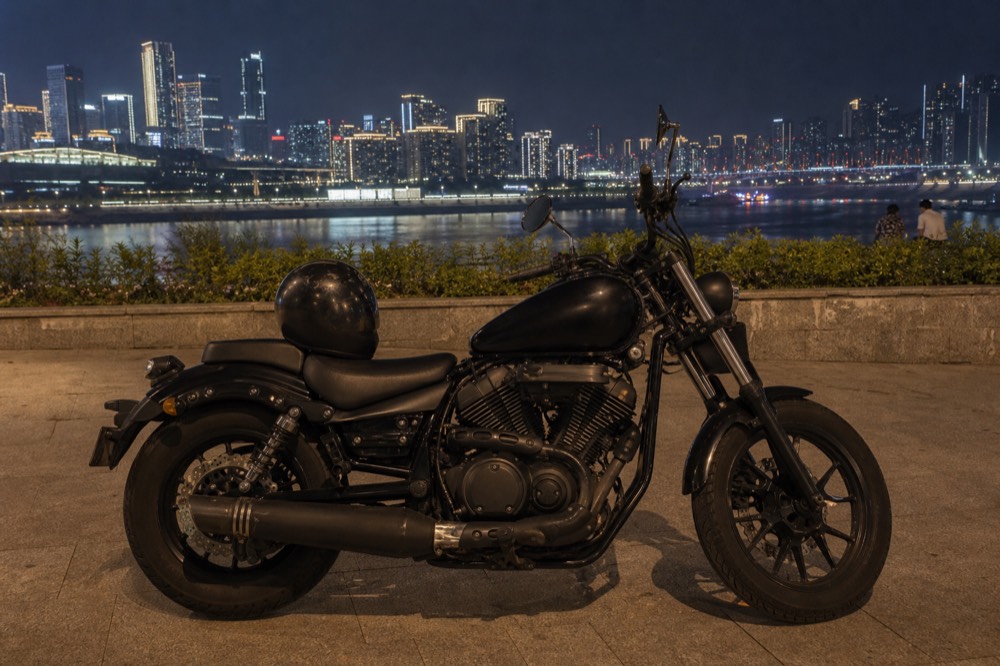
The two packages are not tiers of the same thing, and the operator's own listing is blunt about it: the photo package "only provides static photo shooting services and does not include a motorcycle riding experience". One is a posed shoot with a parked bike on the south bank. The other is a ride, with a professional rider and a photographer following, that produces one edited video of 25 to 35 seconds with action guidance during the ride. Stills are not promised on the video package, though two reviewers reported being sent photos anyway, so the honest wording is "not promised" rather than "never given".
For transport planning the distinction matters less than you might think, because both meet in the same place, in the same window, 18:30 to 22:00, night only, with no daytime slot. What changes is your evening's rhythm: the photo package is 15 minutes of posed shooting, so you can pair it with dinner on Nanbin Road or a walk along the promenade afterwards, while the video package's ride and follow-shoot structure tends to fill the slot. Neither package includes clothing or makeup, so arrive dressed for the shoot you want.
What is the Yangtze River Cableway actually for?
The cableway is a real commuter link that opened in October 1987, crossing 1,166 m of the Yangtze from Xinhua Road in Yuzhong to Shangxinjie and Longmenhao in Nan'an, carrying up to 81 people per cabin at 6 m/s, with a crossing time of 3.6 minutes and a vertical interval of 47 m. It is a working transport line that happens to have a view.
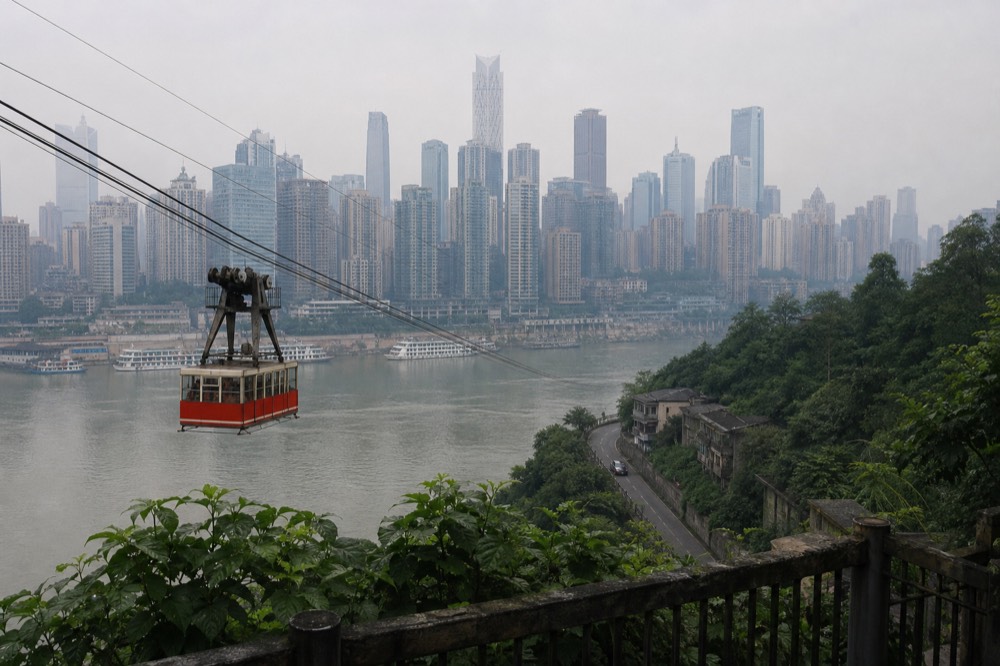
For this article's purposes the cableway has a specific use: it lands you on the south bank. The Shangxinjie end of the line is in the same part of Nan'an as the shoot corridor, and the Longmenhao Old Street area beside Dongshuimen Bridge gives an open, north-facing sightline across to the Yuzhong skyline from the same side of the river you will be photographed on. Construction began in March 1986 and the line opened on 24 October 1987, operated by Chongqing Passenger Cableway Co Ltd. It is a heritage piece of infrastructure that still moves people, and on a clear evening the queue reflects that.
What we will not do is print a fare or a fixed schedule. The operator's own site did not respond when our research pipeline tried to read it, and the operating times that circulate online trace back to a single encyclopedia entry rather than an operator page. Say it plainly: the fare and the seasonal hours are published by the operator, they shift with the season, and checking before you go is a two-minute job that beats a printed number going stale.
How do you get from the airport to the city?
Chongqing Jiangbei International Airport, CKG, is served by metro directly: Terminal 3 has Line 10, and Terminal 2 has Line 10 and Line 3, with first trains from the terminals around 06:30 and last trains between 22:30 and roughly 23:50 depending on direction and terminal, per the airport operator's own published table.
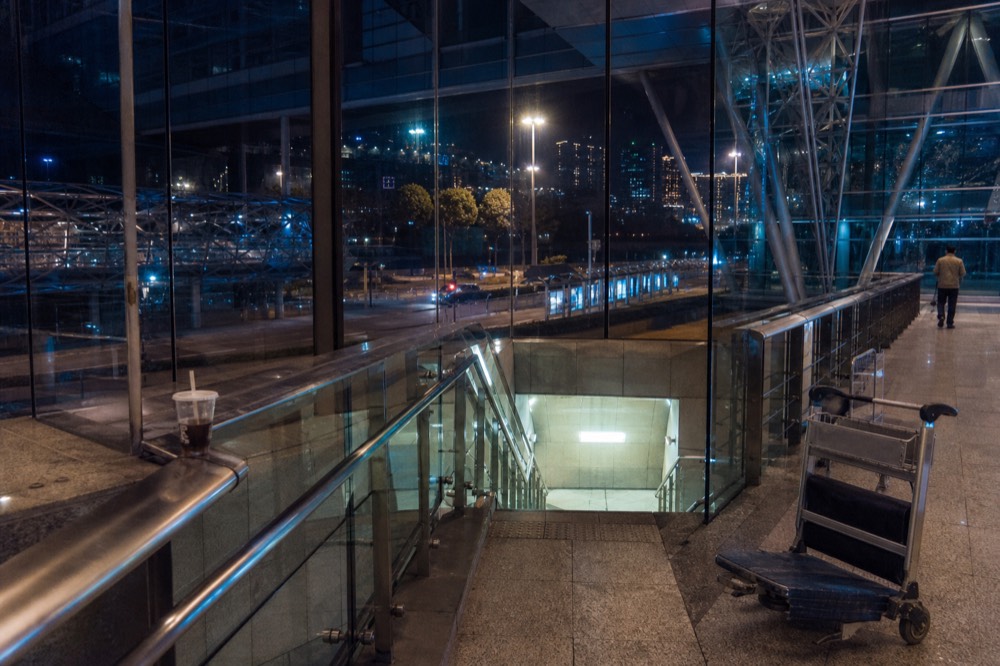
The airport itself is a big operation: IATA code CKG, opened 22 January 1990, four runways, Terminal 3A opened in August 2017 and Terminal 3B in April 2025 serving domestic flights, with international flights staying at T3A. Chongqing's airports together handled 51,126,900 passengers in 2025, up 2.4 percent, per the municipal statistics communique. The airport operator's transport page, at cqa.cn, publishes the line and first-and-last-train table, and it states plainly that Chongqing Rail Transit's own times prevail if the timetable changes.
| Option | Good for | Caveat |
|---|---|---|
| Line 10 from T3 or T2 | The direct, traffic-proof run into the network | No published fare or journey time for the airport-to-city pair exists in any document we could read; the fare is distance-banded and the operator publishes the table |
| Taxi from the terminal | Late arrivals, heavy bags, groups | Metered tariff is the published daytime one, 10 yuan for the first 3 km; distance and traffic decide the rest |
| Airport bus | Some hotel corridors | Schedules change and nothing we could read publishes a current network map; check at the terminal |
| High-speed rail into a city station | Only if you are arriving by train, not from CKG | Journey times between city pairs change with every timetable revision; 12306 is the authority, so we print no time |
On fares, one honest note: the fare structure for Chongqing Rail Transit is set in a municipal price notice and is distance-based, bought at gates or in the app, and the notice itself is published by the municipal development and reform commission at its official page. The operator's app or a station fare table will give you the exact figure for your trip, which is more reliable than any number a travel article could print.
How do you pay for transport as a foreign visitor?
Foreign Visa, Mastercard, Amex, JCB, Discover, Diners Club and UnionPay International cards can be bound to Alipay and WeChat Pay after passport verification, and QR codes from those apps then work at metro gates and in taxis. Cash in RMB is legal tender and refusing it is against the rules, though we found no citable document number for that rule.
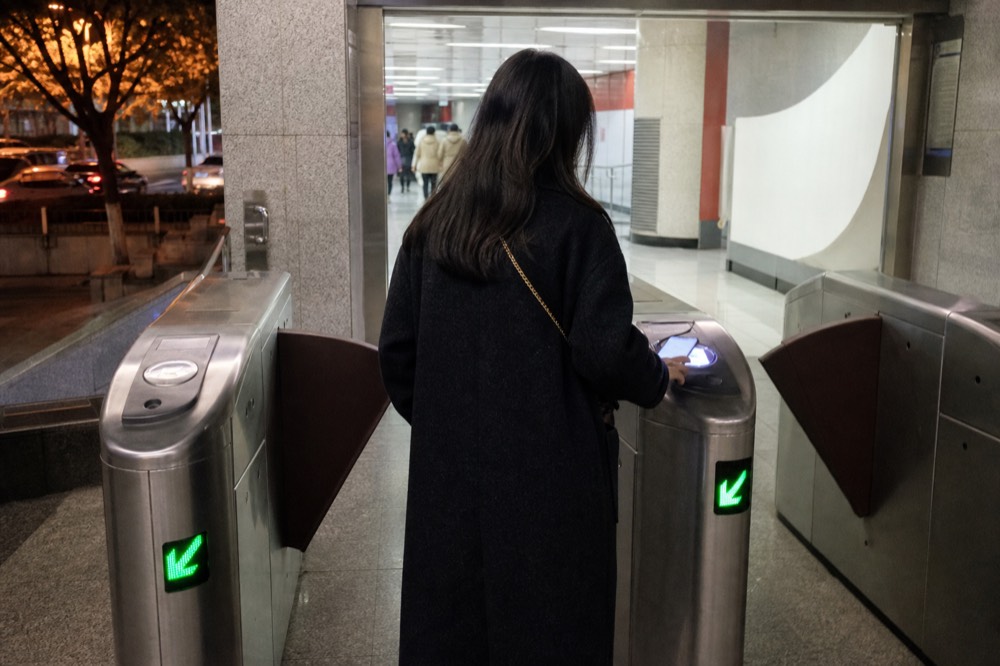
The mechanism is the part to get right before you land. Bind the card in either app, verify against your passport, and the app generates the QR code the gates and taxi readers want. A foreign phone number is generally sufficient for the SMS verification, so a Chinese number is not a prerequisite for basic use. Set both apps up, not just one, because when one misbehaves at a fare gate at 22:10 with a train leaving, the second one is the difference between a story and a walk. We describe the mechanism and print no fee percentage or transaction limit, because every figure we found traces back to traveller guides rather than an official source.
For the shoot itself, the operator's crew communicates by email or WeChat for file delivery within 1 to 3 days, and the listing has recorded 100-plus bookings, so the WeChat route is worth having installed regardless of payment.
What is published, and what must you check live?
The honest summary is this: the network, the station mapping, the cableway's engineering figures, the taxi tariff, the airport rail table and the 22:00 Nanbin Road motorcycle ban are all published and verified, while specific metro fares for your trip, the cableway's seasonal hours, day-pass products, and rail journey times between cities are either operator-published and changeable, or not published in any readable primary source at all.
The distinction matters because most transport articles blur it. The table below is what a reader actually needs: not guessed numbers, but a clean line between what you can plan on and what you must check on the day.
| Item | Status | What to do |
|---|---|---|
| Twelve lines, 324 stations, 574.12 km | Published and verified | Plan on it |
| Station-to-landmark mapping | Verified from each station's own reference | Plan on it |
| Nanbin Road two-wheeler ban, 22:00 to 06:00 daily | Published, in force since 29 January 2024 | Plan on it; it sets the session end |
| Skyline lighting switch-on, 19:30 winter / 20:00 summer | Published by the urban administration bureau | Plan on it, with a two-hour holiday extension over Spring Festival and National Day |
| Metro fare for a specific trip | Set by municipal notice, distance-based, operator-published | Check in the app or at the gate |
| Cableway fare and seasonal hours | Operator-published, seasonal | Check before you go |
| Day passes and discounts | Announced by the operator, not the fare notice | Check with the operator |
| High-speed rail journey times | Change with each timetable revision | Check 12306 |
| Metro operating hours per line | Published as a network summary; per-station tables sit with the operator | Check the operator's site or app for your line and direction |
One final timing fact that closes the loop, and it is the kind of detail that does not surface on a first page of search results. The Loop Line, which serves both Shangxinjie and Danzishi, runs until 22:30 on an ordinary day, 23:00 on public holidays and the day before, per the transport commission's published network summary. The shoot ends at 22:00 because of the motorcycle curfew. So a guest who wants the metro home has half an hour, a riverside walk and a climb to a station, and a taxi, flagged at the daytime rate until 23:00, is the realistic way out. Knowing that before you book is the difference between ending the night calm and ending it sprinting.
The six questions below cover the core of getting around Chongqing for a shoot night: the closest station to the meeting point, the last metro home after the 22:00 finish, the motorcycle curfew that sets that finish, foreign card payment at the gates, the airport rail link, and whether the cableway doubles as practical south-bank transport. Each answer uses only published, verified figures, and points you to the operator wherever the record does not publish a number.
Common questions about getting around Chongqing
Which metro station is closest to the Nanbin Road motorcycle photoshoot?
Danzishi on the Loop Line is the nearest station to Nanbin Bell Tower Plaza, the meeting point, at roughly 1.8 km. Shangxinjie, on the Loop Line and Line 6, serves the west end of the corridor near Dongshuimen Bridge. The crew confirms the exact meeting spot after booking.
Can I get the metro back after the 22:00 session end?
Only just. The Loop Line runs until 22:30 on an ordinary day, and 23:00 on public holidays and the day before, so you have half an hour plus a walk and a climb to the station. A taxi is the realistic option, and the daytime tariff, 10 yuan for the first 3 km, applies until 23:00.
Why does the photoshoot end at 22:00?
Two-wheeled motorcycles are banned on Nanbin Road between the Lanhua Road and Tengjiang Road junctions from 22:00 to 06:00 every day, in force since 29 January 2024. The session window, 18:30 to 22:00, is built around that curfew.
Can I pay for the metro with a foreign card?
Not directly at the gate in most cases, but you can bind a foreign Visa, Mastercard, Amex, JCB, Discover, Diners Club or UnionPay International card to Alipay or WeChat Pay after passport verification, and use the app's QR code at the gates. Cash in RMB is also accepted and refusing it is against the rules.
Does the metro go from the airport to the city?
Yes. Terminal 3 is served by Line 10, and Terminal 2 by Line 10 and Line 3, with first trains from the terminals around 06:30 and last trains between 22:30 and roughly 23:50 depending on direction and terminal. The fare is distance-based and the operator publishes the exact figure.
Is the Yangtze River Cableway a practical way to reach the south bank?
It is. The line crosses 1,166 m from Xinhua Road in Yuzhong to Shangxinjie and Longmenhao in Nan'an in 3.6 minutes, and the south-bank end is in the same part of the district as the shoot corridor. Check the operator's current fare and seasonal hours before you go, as both shift.