Why Is Chongqing Called An 8D City?
The nickname 8D magic city describes Chongqing's vertically stacked street network, built on ridges between two rivers. Here is what the term actually means, which structures prove it, and which claims do not survive checking.
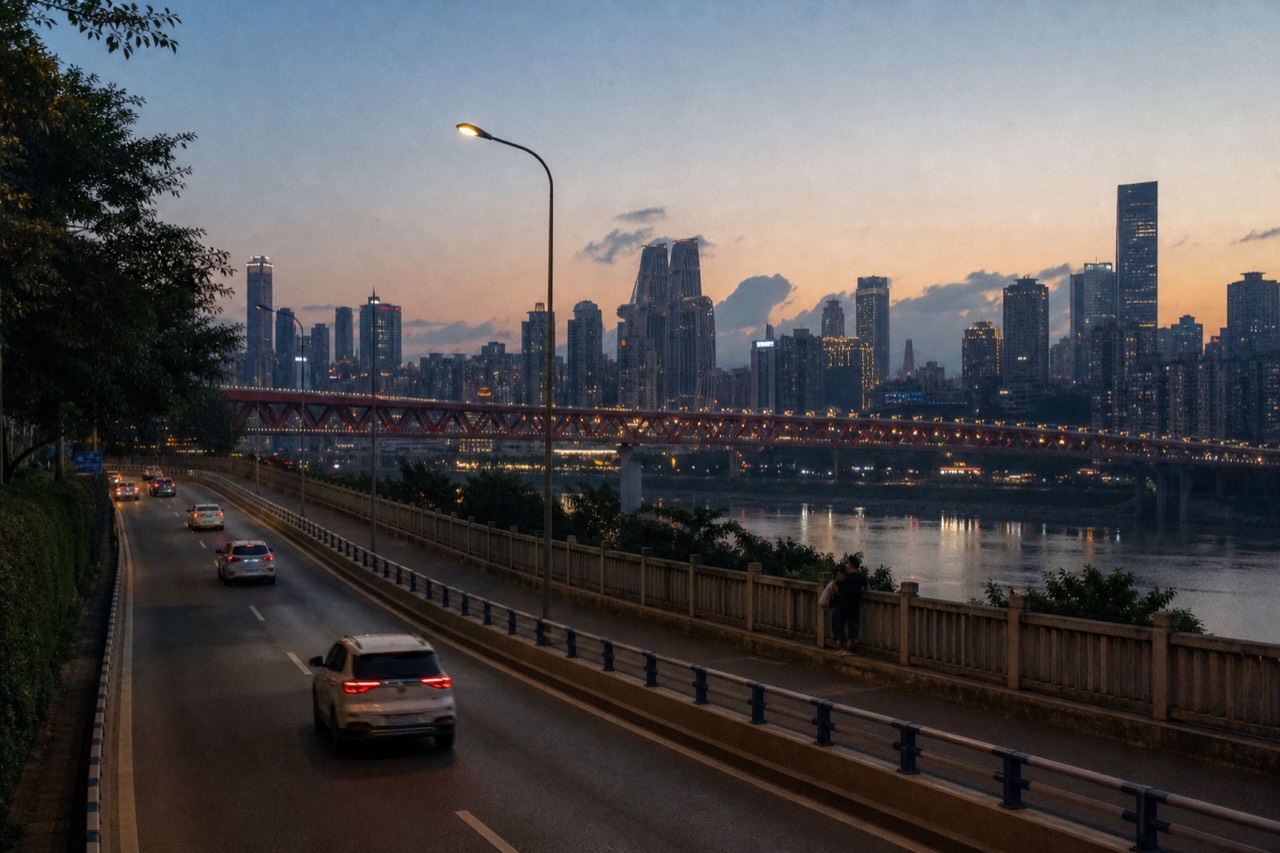
Why Is Chongqing Called An 8D City?
The nickname "8D magic city" (8D魔幻城市) describes a street network stacked vertically: Chongqing is built on ridges between the Yangtze and Jialing rivers, so roads, bridges, tunnels and building entrances sit on many levels at once, and what would be the ground floor in a flat city simply does not exist here. The term comes from popular media, not from any official designation, and it is the framing most visitors now bring to the city.
That is the short answer. The longer one is more interesting, because the nickname is doing something a normal superlative does not: it is a claim about geometry. A city can be old, big, rich or beautiful without changing how you physically move through it. Chongqing is different, and the difference is measurable, in elevation, in bridges, in a rail line that passes through the middle of an apartment block. This page owns the term itself: where it came from, what it describes, which structures people point to as proof, and which parts of the popular story collapse the moment you check them.
Start with what is verifiable. Chongqing counts 105 large and extra-large bridges over the Yangtze and Jialing rivers, with more than 20,000 bridges of all kinds citywide, the basis of its "Bridge Capital" (桥都) title. The Yuzhong peninsula, the downtown core, rises from roughly 160 m at the riverside toward 390 m at its high ground, a vertical range on the order of 220 m, though that figure is assembled from topographic references rather than one authoritative document and should be read as approximate. The city's resident population stood at 31,872,600 at the end of 2025, and its rail network runs 12 lines over 574.12 km. None of that is magic. All of it is geography plus engineering at a scale few cities attempt.
The most direct way to put that vertical skyline in your own frame is the shoot this site covers: a night session on the south bank, a motorcycle as prop or as a pillion ride, and the lit peninsula across the water. The details are in the sections below.
Why Is Chongqing Called An 8D City?
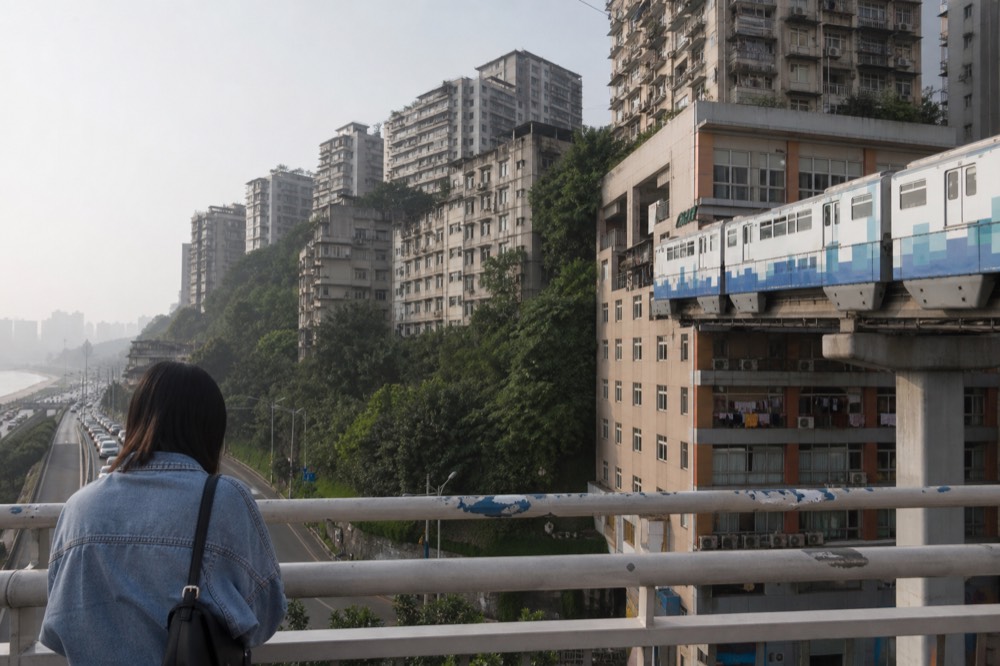
Chongqing earns its "8D city" nickname because its vertical geography makes three dimensions feel insufficient: one trip across downtown can pass through four or five street levels, with buildings entered on the eleventh floor from one road and exited on the first floor onto another, bridges sitting above some neighborhoods and below others, and a monorail threading straight through a residential tower between floors.
The nickname's exact origin is not pinned to any official publication. It is a popular-media term, widely used in Chinese coverage of the city and referenced descriptively by international outlets including CNN's coverage of Chongqing's cyberpunk appeal. That matters for how you should treat it: it is a genuinely accurate folk description, not a statistic. Nobody measured the city and found eight dimensions. But the intuition behind the exaggeration is sound in a way most travel nicknames are not, because the physical claim underneath it, that the street network is stacked rather than spread, is real and checkable.
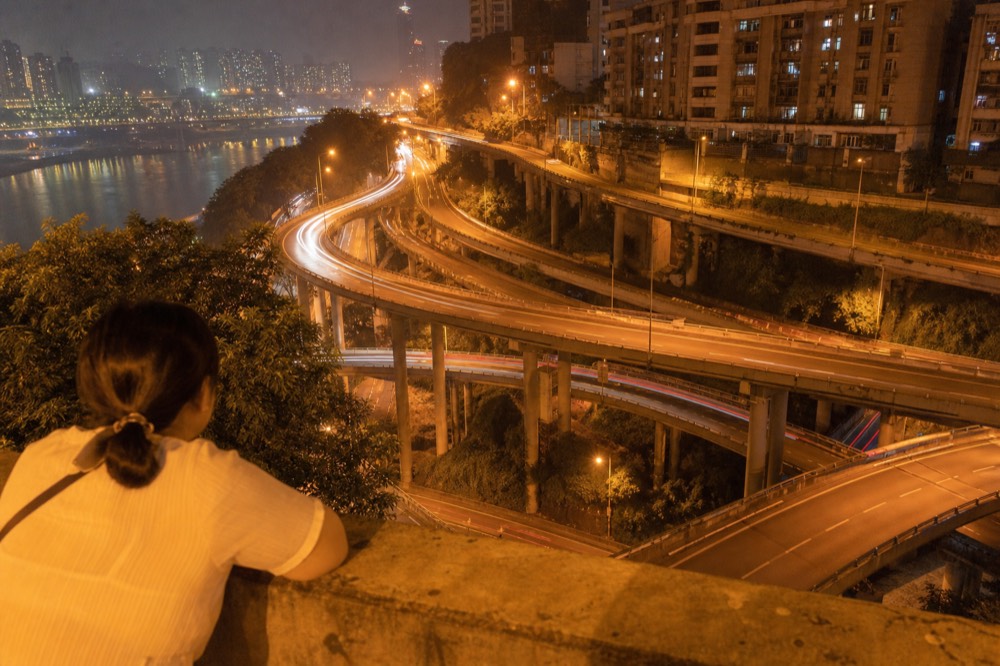
The root cause is terrain. Chongqing sits where the Jialing meets the Yangtze, on a landscape of steep ridges and narrow valleys. A flat city paves over that; Chongqing built with it. Roads follow contour lines, bridges jump the gaps, tunnels punch through the ridges, and because the slopes are steep, buildings on the same block can have entrances at wildly different elevations. The result is a city where vertical position is ambiguous in a way that genuinely disorients first-time visitors, and where a map viewed from above tells you almost nothing about the walk.
The number itself is a joke that stuck. Three dimensions are the physical ones; the "extra" dimensions are the layers of experience, the street that turns out to be a roof, the metro platform that is also a river-view balcony. Chinese internet culture also produced 5D and 7D variants along the way, which this page covers further down. What all the variants share is the same underlying observation: in Chongqing, the assumption that everyone at one spot is at one level fails constantly, and the failure is the fun part.
If the nickname has a single best short proof, it is probably the city's own rail system. Chongqing Rail Transit mixes conventional metro with straddle-beam monorail precisely because the terrain demands it, and its most famous station, Liziba, puts a train through the sixth to eighth floors of a residential building. That is the 8D claim compressed into one structure, and it is fully verified.
What does the 8D nickname actually describe?
The nickname describes vertical stacking, not visual chaos: roads on multiple decks, buildings with entrances at several elevations, transport infrastructure woven through residential blocks, and a bridge count, 105 large and extra-large over the two rivers, that exists because the city cannot be laid out flat. The "8D" experience is what happens when a street network has to solve a mountain range inside a megacity.
Here it helps to separate the nickname's two ingredients. One is the terrain, the ridges between two rivers. The other is the engineering response, which is what actually produces the stacked city. Chongqing built 6,473,100 complete motorcycles in 2025 and is one of the world's great motorcycle towns partly for the same reason its streets feel impossible: wheeled transport has to work on slopes, so the road network is dense, layered and creative. The city's 12 rail lines, 324 stations and 574.12 km of track include monorail and conventional metro, elevated and underground running, sometimes within a single journey.
The structures people cite as proof are specific, and they are worth listing with what is actually verified about each, because the popular versions of some of these claims are looser than the facts:
| Structure | What it actually is | What is verified |
|---|---|---|
| Liziba station | Line 2 straddle-beam monorail station threaded through floors 6 to 8 of a residential building | Opened 18 June 2005; free viewing platform opposite opened in trial operation 22 August 2018 |
| Baixiangju | 1990s cliffside apartment block whose 24 storeys need no lift, because three separate floors open at street level on different hillside terraces | Single-source, widely documented, no primary document located |
| Huangjuewan interchange | Giant stacked interchange in the Danzishi area carrying expressway routes | Opened 11 March 2016; the popular level and ramp counts have no primary source |
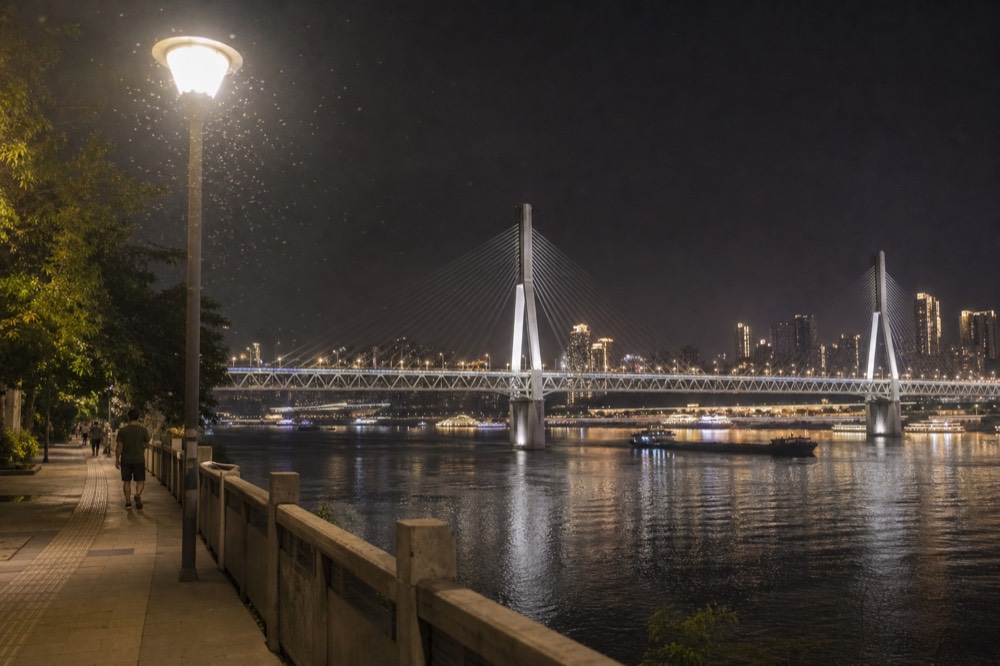
| Dongshuimen Bridge | Double-deck road-and-rail bridge over the Yangtze | Opened 1 April 2014, total length 858 m, longest span 445 m, Line 6 runs beneath the road deck |
| Raffles City Chongqing | Eight-tower complex with the "Crystal" skyway joining the tops of four of them | Opened 6 September 2019, 354.5 m tall, skyway 300 m long atop 250 m towers |
| Yangtze River Cableway | Aerial tramway across the Yangtze | Opened 24 October 1987, line length 1,166 m, crossing time 3.6 minutes |
Notice what the table does and does not say. Every structure on it is real and each one is genuinely strange by the standards of a flat city. But two of the most repeated claims about them, the number of levels at Huangjuewan and the number of tunnels in central Chongqing, are exactly the kind of figure this page exists to check rather than repeat. Both are unresolved: no primary source publishes them.
The terrain numbers deserve their own honest treatment:
| Figure | Value | Status |
|---|---|---|
| Large and extra-large bridges over the Yangtze and Jialing | 105 | Verified, municipal housing and construction commission |
| Bridges of all kinds citywide | More than 20,000 | Verified, same source |
| Yuzhong peninsula riverside elevation | Roughly 160 m | Approximate, assembled from topographic references |
| Yuzhong peninsula high-ground elevation | Roughly 379 to 391 m | Approximate, treat qualitatively |
| Road tunnels in the central urban area | No published count | Unresolved; print no number |
| Resident population, end of 2025 | 31,872,600 | Verified, statistical communique |
The lesson of the second table is the same as the lesson of the first. The verified facts about Chongqing's verticality are already extraordinary without inflation. A peninsula rising more than 200 m from river to ridge, carrying a downtown of that size, with 105 major bridges stitching it to both banks, does not need a made-up tunnel count.
Is the Huangjuewan interchange really eight levels?
No published source confirms any level count for the Huangjuewan interchange, and the widely repeated "eight levels, twenty directions" line has no primary source behind it. What is verified is narrower but real: the interchange opened on 11 March 2016, it sits in the Danzishi area of Nan'an District, and it carries the Chongqing Inner Ring Expressway together with other express routes. The level count you have read is a folk figure.
This is the debunk at the heart of the 8D story. Huangjuewan is genuinely spectacular, a stack of ramps folded into a hillside that looks, from a drone shot, like a knot. Because it looks like a knot, people quantify it, and the quantification spread faster than anyone could check it. Multiple research passes looking for the level count and the ramp count found nothing authoritative: no government notice, no engineering paper, no official page. The honest statement is that the interchange's exact geometry is not published, and that visitors should describe the experience rather than repeat the numbers.
There is a second, stranger fact about Huangjuewan that matters for this site's readers specifically: you cannot ride a motorcycle on it. Motorcycles are barred from the Inner Ring Expressway, so the interchange exists as a viewpoint and a backdrop, not as a route. The viral motorcycle videos that make Chongqing look like a continuous rollercoaster are shot on the riverside roads, above all Nanbin Road, not on the expressway stacks.
The pattern repeats elsewhere. Ask how many tunnels run under central Chongqing and you will find confident numbers in travel content and no document behind them. Ask for the exact floor the Kuixinglou pedestrian bridge meets and you find the famous "walk in at street level and you are on the 22nd floor" claim unconfirmed by any primary source across repeated checks. The 8D city nickname is accurate. Half the arithmetic attached to it is not.
How do you photograph a city with no ground floor?
You work the vertical sightlines: shoot the skyline from a south-bank vantage like Nanbin Road or Longmenhao Old Street, shoot down from Eling Park or a tower observation deck, shoot across from a bridge, and let the layers stack inside a single frame. Night is when the stacking reads most clearly, because the lit levels separate visually, which is exactly why the viral Chongqing format is a night format.
Chongqing rewards photographers who give up on the idea of a level horizon. The city's decorative skyline lighting switches on at fixed clock times, 20:00 in summer, 19:30 in winter, so from a south-bank position the whole peninsula ignites at once, and every deck of the city from river to ridge becomes a separate band of light. The classic establishing shots work precisely because vertical range is the subject: Dongshuimen Bridge in the foreground, the peninsula's towers climbing behind it, the cableway cabins drifting across on their 1,166 m line.
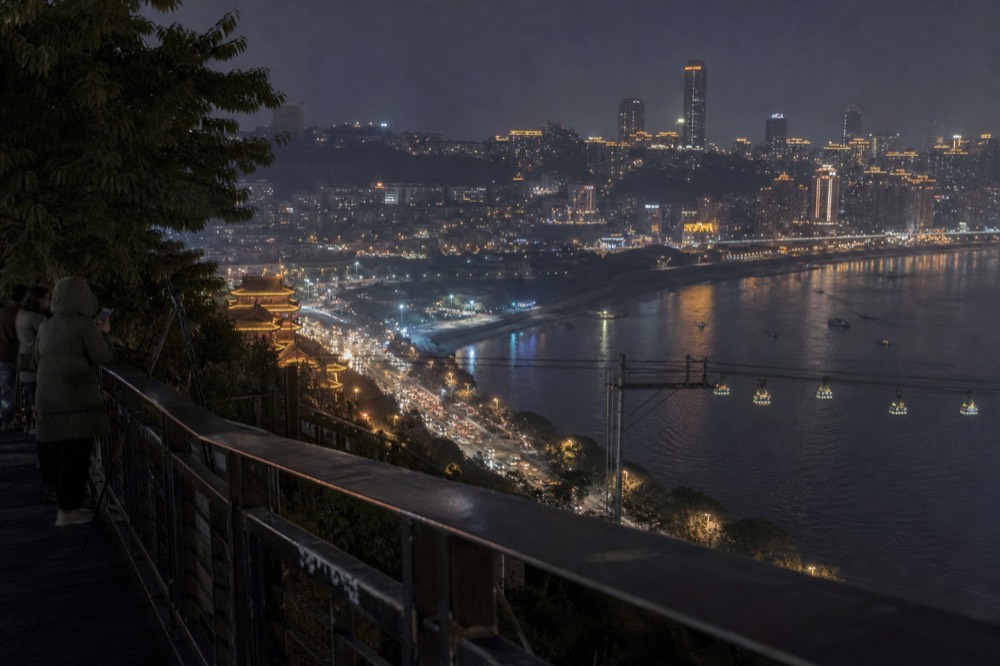
For a deeper dive into the specific vantage points, the shot-by-shot breakdown lives in our Chongqing cyberpunk photo spots guide, and the question of whether Chongqing is the world's most futuristic-looking city is handled in why Chongqing feels so futuristic. This page owns the definition; those own the shot list and the comparison.
One format has come to dominate, and it is no accident that it was invented here. A rider and a passenger on a motorcycle, the stacked skyline behind them, a short edited clip shot from a following bike: the vertical city in motion. If you want the stills version of that idea, a posed shoot with a motorcycle as a prop on the Nanbin Road side of the river, the photo package below is the one to look at.
The photo package is deliberately narrow: 15 minutes of posed shooting with a parked bike, all the negatives plus nine retouched photos, no ride at all. It exists for people who want the vertical skyline and the machine in one frame without getting on one.
What other structures prove the 8D label?
The strongest proofs are Liziba station, where a monorail runs through the sixth to eighth floors of a residential block, Baixiangju, a 24-storey cliffside building that needs no lift, and the bridge network, 105 large crossings that exist because the terrain gives no alternative. Each one demonstrates the same thing: in Chongqing, infrastructure and buildings interpenetrate instead of sitting side by side.
Liziba deserves the emphasis even though its full account lives elsewhere. The station opened on 18 June 2005 as part of Line 2, and the building around it was designed with the railway through its middle. The free viewing platform opposite, in trial use since 22 August 2018, exists because so many people wanted the shot that the city built them somewhere to stand. That is the 8D economy in one sentence: the city's strangeness is now its product, complete with purpose-built spectator infrastructure.
Baixiangju is the quieter proof and, honestly, the more subversive one. A 1990s apartment block where three different floors open to street level on different terraces, so residents on the 24th floor and residents on the first floor can both walk straight out their doors, is the 8D idea applied to ordinary housing rather than to a monument. The claim is single-source, though widely documented, so treat the specifics with the usual caution.
And then there is the nightlife of the whole thing, which is where the motorcycle comes in. The viral format this site is built around, riders and passengers filming along the south bank against the lit peninsula, works because the backdrop is a city that photographs as a wall rather than a skyline. More than 1.52 billion views have accumulated across related videos, and the Douyin topic dedicated to the Chongqing "landing visa" format had passed 380 million plays by late May of the breakout year. The 8D nickname made people curious. The videos, and the shoot you can book, gave them something to do about it.
The Internet-famous Motorcycle Photo & Video Experience is the listing behind that whole cluster: night sessions from 18:30 to 22:00 on the Nanbin Road corridor, from about $52.85 per person, with free cancellation and no published cancellation window, so check the live listing's terms when you book. It is a way to enter the 8D city rather than just look at it.
Are the 5D and 7D versions of the nickname real?
Yes and no. The variants exist in Chinese internet usage, but 8D is the form that stuck, and the progression from 5D upward tracks the escalating exaggeration of the same single observation, that the city is vertically stacked. There is no official taxonomy, no body that certifies a city as 5D rather than 8D, and the numbers should be read as escalating slang rather than as measurements.
| Variant | What it is | What is real about it |
|---|---|---|
| 5D city | Earlier, less common variant of the nickname | Describes the same stacking, with a smaller number for rhetorical effect |
| 7D city | Occasional intermediate variant | No fixed meaning; the number is arbitrary |
| 8D magic city (8D魔幻城市) | The standard form, a popular-media term | The most widely used; no official originating publication exists |
| Cyberpunk city | The international framing that overlaps with 8D | Describes the visual effect, neon plus verticality, rather than the geometry |
The honest way to read the progression is as a joke with an escalation problem. Once a city is "5D", someone will call it "6D", and the internet settles where the laughs are. Eight is where it settled. What never changed is the observation underneath, and that observation survives every check you can throw at it: the peninsula rises more than 200 m, the bridges number in the hundreds, the monorail goes through a tower, and the apartment block skips the lift.
For the wider question of what else Chongqing is known for beyond the nickname, our what Chongqing is famous for piece covers the rest of the list, from the hotpot to the river crossings.
Why does the nickname matter now?
The 8D label matters now because it became the entry point to a tourism surge: Chongqing drew 2,147,800 inbound overseas visitors in a recent year, its airport checkpoint was China's fastest-growing among the ten largest, and the nickname is the phrase that routes curious travellers toward the monorail, the bridges and the motorcycle videos that document all of it. The term is the doorway; the geography is the room.
The nickname also explains this site's existence. A vertically stacked city that lights itself like a set at 20:00, with a motorcycle culture rooted in the industry that built 6.47 million machines in 2025, produces exactly one obvious consumer product: a way for a visitor to put themselves inside the frame. That is the idea Chongqing Motorcycle Photoshoot is built around, a night shoot on the south bank that puts the whole stacked skyline behind one rider. It is why the 8D question, seemingly a bit of internet trivia, is worth a page of its own. The answer to "why 8D" is the answer to "why Chongqing, and why like this".
For a sense of how the whole visual phenomenon reads today, the framing that international coverage gave the motorcycle trend, the Global Times report on the Chongqing "landing visa" describes the corridor this site's tours shoot on, riders weaving along Nanbin Road with the skyline across the water. And for the bridge count that underwrites half the 8D claims, the municipal commission's own announcement is the primary source.
Before the questions, the full comparison of the two ways to book the shoot, posed photos versus the pillion-ride video, is laid out in our guide to choosing the photo or the video session.
The 8D nickname is the single most common question people bring to Chongqing, and the answers below cover the essentials: the literal meaning of 8D magic city, whether the Huangjuewan level count holds up, which structure proves the label best, how many bridges the city actually has, and what the 5D and 7D variants mean. Each answer sticks to what is verified and flags what is not.
Common questions about the 8D city nickname
Why Is Chongqing Called An 8D City?
Because its street network is stacked vertically rather than spread flat: the city is built on ridges between the Yangtze and Jialing rivers, so roads, bridges, tunnels and building entrances sit on many levels at once. The Chinese nickname is 8D magic city, a popular-media term with no official origin, and it describes a real geometric condition rather than a marketing claim.
Is Chongqing really eight-dimensional?
No, and nobody claims it literally is. The "8D" is internet exaggeration for the experience of moving through a city where vertical position is ambiguous: entrances on multiple floors, bridges above neighbourhoods, a monorail through a residential tower. The three physical dimensions are all there are; the nickname says the city uses them in unusual ways.
Does the Huangjuewan interchange really have eight levels?
No published source confirms any level count for it. The interchange is real and spectacular, opened on 11 March 2016 in the Danzishi area, but the "eight levels, twenty directions" line has no primary source. Motorcycles are also barred from the expressway it carries, so it is a backdrop, not a riding route.
Which structure is the best proof of the 8D nickname?
Liziba station, where the Line 2 monorail passes through the sixth to eighth floors of a residential building, is the most cited and fully verified example. Baixiangju, a 24-storey cliffside block whose residents need no lift because three floors open at street level, is the quieter everyday proof, though that account is single-source.
How many bridges does Chongqing have?
105 large and extra-large bridges over the Yangtze and Jialing rivers, and more than 20,000 bridges of all kinds citywide, according to the municipal housing and urban-rural construction commission. The count is the basis of the city's "Bridge Capital" title.
What does 8D magic city mean in Chinese?
The term is 8D魔幻城市, literally "8D magical city". It is a popular-media nickname with no official originating publication, widely used in Chinese coverage and now internationally. Variants such as 5D and 7D exist but never stuck; 8D became the standard form.